
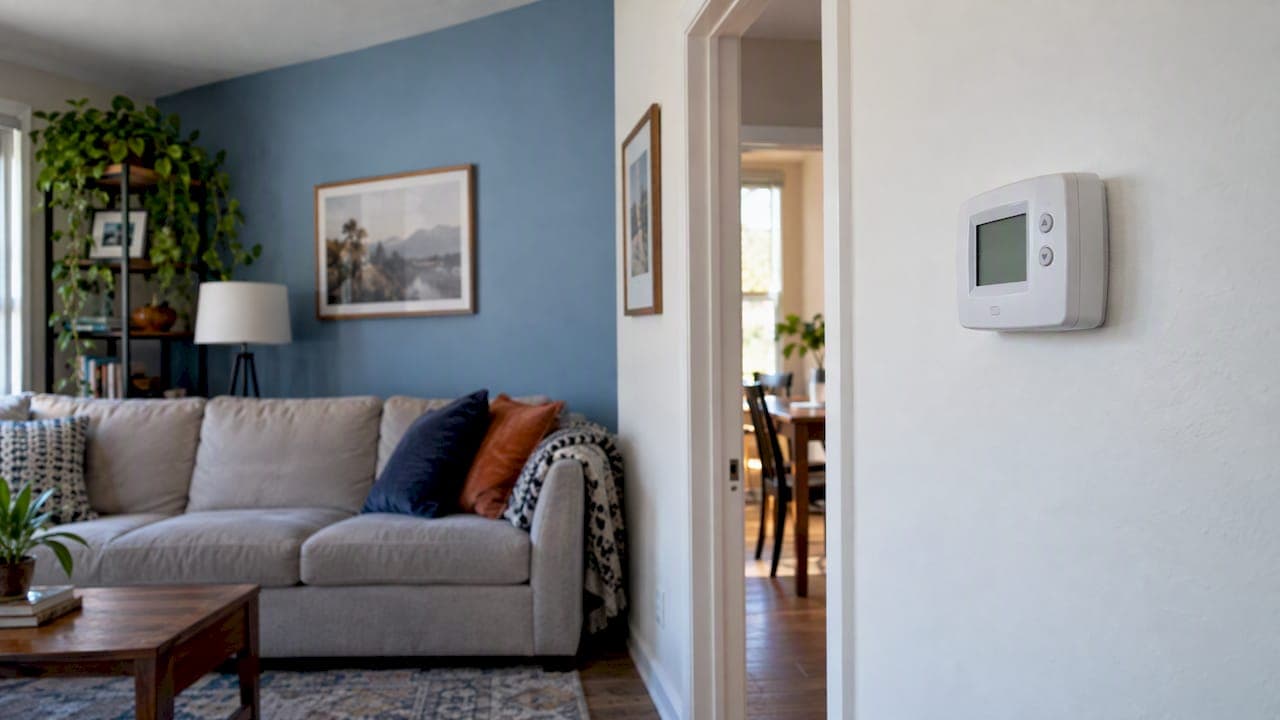
Put your thermostat on an interior wall in a room you use often, about 5 feet above the floor, away from sunlight, vents, drafts and heat-producing appliances. That one decision controls how your air conditioner or furnace behaves all day, because the thermostat can only act on the temperature it senses at its own spot on the wall. In a hot-summer market like Avondale, a thermostat that reads two or three degrees wrong means a system that runs when it shouldn't, or quits before the room is comfortable.
Below you'll find the exact placement rules, the spots that fool a thermostat, what to do when your current location is bad, and how to choose between a smart and a programmable model once you've picked the spot.
TL;DR
- Mount it on an interior wall, in a frequently used room, about 5 feet (1.5 m) off the floor, where air moves naturally.
- Keep it away from direct sun, windows, doors, supply vents, kitchens, lamps and furniture that blocks airflow.
- Don't chase the coldest or hottest room. The thermostat should read the typical temperature of the home.
- Programmable models follow a schedule you set; smart models learn habits and let you control them from a phone.
- If the wall location is wrong or the house has uneven rooms, the fix may be a relocation, zoning or an airflow repair, not a new thermostat.
Table of Contents
- Why placement changes what your system does
- The best location for a thermostat
- Where not to put a thermostat
- Should the thermostat be in the coldest room?
- Special cases
- Smart vs. programmable: which thermostat suits your spot and your schedule
- Perspective: when the thermostat isn't the problem
- How to check your current thermostat location
- When it's time to call a pro
- Is your comfort problem really airflow? Let us look
- FAQ
- Sources
Why placement changes what your system does
A thermostat is a small sensor wired to a big machine. It doesn't know what the rest of the house feels like. It knows the air touching it. If that air is warmed by afternoon sun through a window, your A/C thinks the whole house is hot and overcools the other rooms. If it sits in a cold draft, your furnace runs longer than needed.
The Vermont Energy Saver guide says location affects a thermostat's performance and efficiency, and recommends a spot with natural room-air currents and convenient access for programming. A manufacturer installation guide adds a practical reason: stagnant air doesn't accurately reflect how quickly a room's temperature is changing, so a dead-air corner gives sluggish, misleading readings.
So the goal is simple: the sensor should experience the same air your family or staff experience most of the day.
The best location for a thermostat
Four rules cover almost every house.
1. An interior wall
Exterior walls pick up outdoor heat and cold. In Arizona, a west-facing exterior wall can be hot to the touch by late afternoon, and the thermostat mounted on it will report a warm house when the living room is fine. Vermont Energy Saver and the Minnesota Commerce thermostat guide both point to interior walls, away from direct sunlight, drafts, doorways, skylights and windows.
2. A room you actually use
The room where you spend your waking hours should be the room the thermostat protects. The installation guidance for a smart thermostat calls for a frequently used room on an inside wall. A living room or main hallway that connects living spaces usually works. A spare bedroom, a laundry room or a back hallway you rarely enter does not.
3. The right height
The published numbers differ slightly by manufacturer, and all of them land in the same band:
| Source | Recommended height |
|---|---|
| Smart thermostat installation guide | About 5 feet (1.5 m) above the floor |
| Johnson Controls PENN guidance | 4 to 5 feet (1.2 to 1.5 m) |
| Crestron | 60 inches above the finished floor, with at least 12 inches of clearance from corners or molding |
| Cadet (baseboard heat) | About 5 feet, preferably on an adjacent wall, not directly above a fan heater |
If your product's manual gives a number, follow the manual. Otherwise, roughly eye to chest level for an adult is the target. Too low and the sensor reads cooler floor air; too high and it reads warm air that rises to the ceiling.
4. Open airflow around it
Keep the wall space around the thermostat clear. Minnesota Commerce says furniture shouldn't sit in front of or below it, because it blocks natural air movement. A sofa, a bookcase or a tall plant can trap a pocket of air that no longer matches the room.
Where not to put a thermostat
Each of these creates a false reading for a specific reason.
- Direct sunlight. Even a narrow patch of sun for an hour a day can warm the sensor. In a desert climate, this is the most common cause of a thermostat that seems to "run the A/C all afternoon."
- Near supply vents. A thermostat that sits in the stream of cooled or heated air will see the supply temperature, not the room temperature. Setup guidance from ecobee lists supply heating or cooling sources, incandescent lights, exterior or poorly insulated walls, and kitchens or other hot, humid areas among the places to avoid.
- Windows, doors and skylights. Drafts and radiant heat reach the sensor long before they reach the room.
- Kitchens and bathrooms. Ovens, dishwashers and showers add heat and humidity in bursts.
- Corners, alcoves and behind open doors. The installation guide we cited above warns against corners, alcoves, damp areas, and walls adjacent to unheated rooms, stoves or hot-water pipes.
- Lamps and electronics nearby. Johnson Controls notes that water pipes, lamps, windows, doors, sunlight and other heat or cold sources can all change what the thermostat senses.
- A hallway with a return grille right below it. This is a very common situation in tract homes, and it deserves its own look (see below).
Should the thermostat be in the coldest room?
No. It's an understandable instinct: if the coldest room is comfortable, everything else will be too. In practice it works the other way around. The thermostat controls the whole system from a single reading, so a sensor in the coldest (or hottest) room tells the equipment the entire house is colder (or hotter) than it is. The other rooms then get overheated or overcooled to satisfy one outlier.
The better approach is a spot that senses the average. Johnson Controls' guidance describes placing a thermostat where it senses average room temperature, and the same logic applies to a whole house. If one room is always much hotter or colder than the rest, that room has a separate problem to solve: airflow, insulation, duct leakage or a system sized for a different layout. We cover the most common version in our guide to why upstairs is hotter than downstairs.
One more point about the dial itself. Vermont Energy Saver notes that turning a thermostat way up in a cold room won't necessarily warm it faster than setting it to the temperature you want. The same logic applies in summer: setting 65°F doesn't cool the house faster than 75°F, it just asks the system to keep running longer.
Special cases
A thermostat in a hallway next to a return duct
This is the setup many homeowners ask about: a thermostat in a hallway outside the bedrooms, with a return grille directly below. The hallway can be fine if it's central and air circulates there, but a return grille pulls air past the sensor at its fastest, and that air may be a blend from several rooms or a stream from a closed-door bedroom. If the readings seem off, compare the thermostat to a separate room thermometer placed at the same height in the main living space for a day. A consistent gap of a few degrees is a sign the spot isn't representative.
Two-story homes
Heat rises, so the upstairs is typically warmer in summer. Cadet and others recommend a central location in large spaces. For a single-thermostat two-story home, the first or ground floor main living area is usually the best compromise, but a single sensor will never perfectly balance both levels. Ask about zoning if one floor is chronically uncomfortable.
Zoned systems and mixed-use buildings
Zoning uses multiple thermostats and dampers so each area is controlled separately. Vermont Energy Saver says zoning can heat or cool occupied areas more comfortably than unused rooms. For a small office, a retail space with a sunny storefront and a back storage room, or a property with units that are used on different schedules, this is often a better answer than moving one thermostat around. Put each zone's thermostat in the space that zone serves, using the same rules above.
Rooms with unit heaters or baseboard heat
Some heaters need special placement. Johnson Controls' guidance for unit heaters puts the thermostat below and behind the heater in the entering-air flow, not in the discharge air. Follow the equipment manual for anything that isn't a standard central system.
Smart vs. programmable: which thermostat suits your spot and your schedule
Once the location is right, the next question is which type to mount there. Vermont Energy Saver separates thermostats into three types: manual, programmable and smart. Manual units need you to adjust them by hand. Programmable models schedule temperature changes by time and day, while smart models learn preferences and support remote control by smartphone.
| Programmable | Smart (Wi-Fi) | |
|---|---|---|
| How it decides | Fixed schedule you enter | Learns routines, can respond to whether anyone is home |
| Remote control | No | Yes, by app or computer |
| Typical features | Weekday/weekend schedules, overrides, vacation settings | Usage reports, energy-saving suggestions |
| Needs Wi-Fi | No | Yes |
| Best fit | Predictable routines, simple setup | Changing schedules, multiple properties, remote monitoring |
The Minnesota Commerce guide says programmable thermostats provide multiple daily modes, weekday and weekend settings, overrides and vacation settings, and many models can also run air exchangers, humidifiers and heat pumps. It describes smart thermostats as Wi-Fi enabled, controllable by app, able to adjust depending on whether anyone is home, and typically including usage reports and energy-saving tips. ENERGY STAR's consumer guidance says smart thermostats can offer more convenience, savings and control than manual or programmable ones.
Which one should you choose?
- Choose programmable if your household or business keeps a regular routine, you don't want another device on your Wi-Fi, and you'll actually set the schedule.
- Choose smart if your schedule changes, you want to adjust the system from your phone, you rent out a property, or you manage several units and want to see what each one is doing. Smart building technology for property managers is a useful place to see how connected devices fit into a larger building setup.
Whichever you pick, a smart or programmable thermostat can't compensate for a bad location. A sensor in the afternoon sun will make a flawless schedule useless. Fix the spot first.
For starting temperatures, Minnesota Commerce suggests winter settings of 66°F to 68°F and summer settings of 74°F to 76°F, then adjusting temperatures or schedule times to balance comfort and energy savings. Arizona summers mean many households land at the upper end of that range.
Perspective: when the thermostat isn't the problem
We clean and repair ducts and vents for a living, so we see the other half of this story. Homeowners often call after moving the thermostat, replacing it, or buying a smart one, and the real problem is still there. A few patterns come up again and again.
A room that never gets cool is often a airflow issue: a crushed or disconnected duct, a blocked or dirty vent, a clogged filter, or a duct run that was never balanced for that room. A thermostat that is placed perfectly will still read "fine" in the living room while the back bedroom bakes. Moving the thermostat toward the problem room just shifts the discomfort somewhere else.

So our advice is to work in this order. Choose a good, representative location. Check the filter and make sure supply and return vents are open and unblocked. Then look at the ducts. Our article on how HVAC airflow affects air quality and energy savings explains why restricted airflow makes a system run longer for less comfort. If you want to see what else is worth doing for your bills, our HVAC energy saving tips for Avondale cover the basics. And if humidity is part of how the house feels, read the role of humidity in HVAC.
One more thing we'd tell a neighbor: if a duct problem and a thermostat problem look alike, test the cheap theory first. Hold a separate thermometer next to the thermostat for a day. If they agree and the room is still uncomfortable, the thermostat is doing its job and the problem is in the air delivery. If a room has persistent hot or cold spots, an air exchanger installation may be one of the options worth discussing for ventilation, alongside duct and filter checks.
— Shaun
How to check your current thermostat location
You don't need tools for a first check.
- Look at the wall. Is it an interior wall? Is there a window, door or kitchen on the other side or within a few feet?
- Watch the sun. Check the thermostat at 2 p.m. and again near 5 p.m. Direct light on it, even briefly, is a problem.
- Feel for airflow. Hold a tissue near the thermostat. A steady stream from a nearby vent means the sensor is in the supply path.
- Check the height. Measure from the floor to the center of the thermostat. About 5 feet is the target.
- Compare readings. Put a basic room thermometer at the same height in the main living area for 24 hours and compare with the thermostat display.
- Clear the area. Move furniture or plants that block the wall below or beside it.
If you find a problem and decide to move the thermostat, remember it's low-voltage wiring on most systems but it still means opening a wall and patching, and some systems use line-voltage or other equipment. Turn off power to the system before you touch any wiring, and have an HVAC technician relocate it if you're unsure which type you have.
When it's time to call a pro
Call an HVAC professional when:
- The thermostat is in a poor spot and needs to be relocated or wired to a new location.
- One room or floor stays much hotter or colder than the rest even with the thermostat in a good location.
- You want a zoned system or additional thermostats for a property with different uses.
- The system short-cycles, turns on and off frequently, or the A/C runs nonstop on moderate days.
- You see dust blowing from vents, weak airflow, or musty smells, which point to the ducts rather than the thermostat.
We can help with the cleaning, repair and replacement side. See our A/C repair and heating services, or our services page for ductwork repairs, duct installation, air filter replacement and air vent replacement. For commercial spaces, our commercial air duct cleaning includes flexible scheduling.
Is your comfort problem really airflow? Let us look
If your thermostat is in a good spot and the house still doesn't feel right, the cause is often inside the duct system. We provide air duct cleaning and air vent cleaning for homes and businesses in Avondale, plus air duct replacement when ducts are beyond cleaning. Our work is backed by warranties, and we offer flexible scheduling including after-hours options. Reach us through our home page to describe what's happening, and we'll tell you whether it sounds like a thermostat, a vent or a duct issue.
FAQ
What is the best height for a thermostat?
About 5 feet (1.5 m) above the floor is the most common recommendation. Manufacturer guidance ranges from 4 to 5 feet on the low end to 60 inches on the high end, so check your product's manual. Mount it on an interior wall with clearance from corners and trim.
Where should a thermostat not be placed?
Avoid direct sunlight, windows, doors, exterior walls, supply vents, kitchens, lamps and corners. Also avoid walls beside unheated rooms or hot-water pipes and anywhere furniture blocks the air. Each of these makes the thermostat read a temperature that doesn't match the rest of the house.
Should the thermostat be in the coldest room?
No. One sensor controls the whole system, so a reading from the coldest room makes the system overheat everything else. Place it in a frequently used, central space on an interior wall, and solve a cold room's problem with airflow, insulation or zoning.
Is a smart thermostat better than a programmable one?
It depends on your routine. A programmable model follows a fixed schedule and is simple and reliable if your days are predictable. A smart thermostat adds Wi-Fi control, learning and usage reports, which helps when your schedule changes or you manage more than one property.
Does thermostat placement matter with a smart thermostat?
Yes. A smart thermostat still reads the air around it, so a sunny wall or a vent in the airflow will skew its readings just as it would a basic model. Choose the location first, then the features.
Sources
- Controls & Thermostats, Vermont Energy Saver
- Thermostat Options, Minnesota Commerce
- Smart Thermostat User Guide
- Locating, PENN Controls installation guide, Johnson Controls
- Determine the Mounting Location, Crestron
- Thermostats, Cadet
- ecobee setup guide and troubleshooting
- How to Choose a Smart Thermostat, ENERGY STAR