
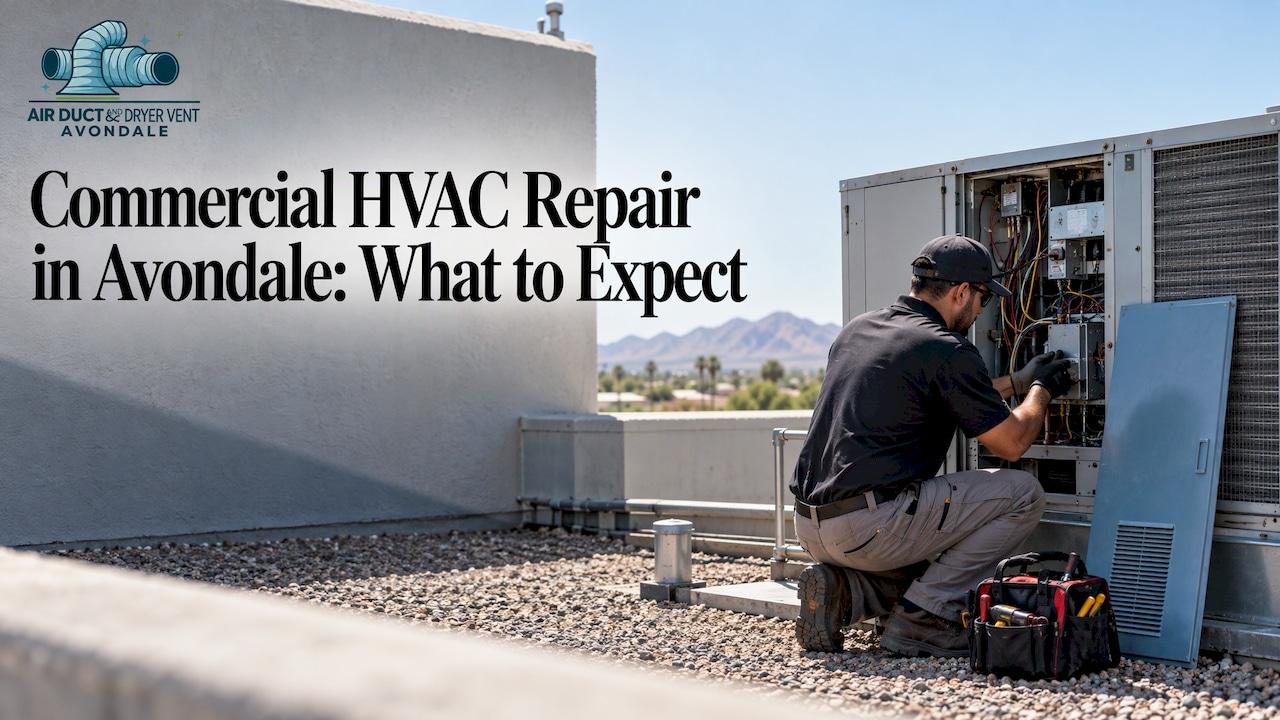
Commercial HVAC repair is the diagnosis and correction of faults in a building's heating, cooling and airflow equipment, from rooftop units and compressors to controls, thermostats and ductwork. In Avondale, where a failed cooling system can shut a shop, office or clinic down within hours, the right move is to know the warning signs, call early, and choose a contractor who explains the fault, the fix and the price in writing before work starts. This guide covers what a repair includes, what it costs to ignore the early signs, how a visit runs, and when after-hours service is worth it.
TL;DR
- Commercial repair covers diagnostics, motors and fans, refrigerant, electrical parts, thermostats and controls, plus airflow and ductwork.
- Rising energy bills, hot and cold spots, odd noises and smells are early signs. Call before a small fault becomes a compressor job.
- A good visit ends with a written fault assessment, an approved scope, verified operation and a record you can keep.
- Call after hours when a failure threatens safety, inventory or operations. Ask about trip charges and repair timing first.
- Preventive maintenance and clean ductwork cut breakdowns. We handle repair, heating and commercial duct cleaning for Avondale properties.
Table of Contents
- What commercial HVAC repair actually includes
- Signs your commercial system needs repair
- The failures that cost the most
- How a commercial repair visit works
- When to call for after-hours HVAC service
- Cutting breakdowns before they happen
- Perspective: why cleaning and repair belong together
- Get your Avondale property covered
- FAQ
- Sources
What commercial HVAC repair actually includes
Commercial systems are larger and more varied than home systems. A strip mall may run several rooftop package units. An office may have split systems with building controls. A restaurant may have makeup air and exhaust on top of its cooling. Repair work reflects that range.
Typical repair work, as described by commercial service providers, covers emergency troubleshooting, blower motor and fan problems, refrigerant leaks and recharge, thermostat failures and electrical diagnostics. Beyond those, a service call often reaches into airflow, filters, coil condition, belts, motors and controls. The exact scope depends on the equipment and the problem you report.
In practice, repair work falls into a few groups:
- Mechanical: fans, blower motors, belts, bearings, compressors.
- Refrigerant side: leak finding, repair, recharge, coil problems.
- Electrical and controls: contactors, capacitors, control boards, thermostats, building automation faults.
- Air distribution: filters, ducts, vents, dampers and balance.
- Heating: furnaces, heat pumps and other heating equipment.
We cover much of this for Avondale properties through our A/C repair and heating services, and we also handle ductwork repairs, air duct and vent replacement, and filter replacement, so airflow problems do not get passed from one contractor to the next.
Signs your commercial system needs repair
Most big failures announce themselves. The trouble is that staff get used to a noisy unit or a warm corner and stop reporting it. Here is what to watch for.
Energy bills climbing without a reason
One common early indicator is a utility bill that rises 10 percent or more with no change in occupancy, operating hours or weather. The same source notes that dirty condenser or evaporator coils alone can cut efficiency by 10 to 15 percent. If your bill jumps and nothing else changed, the system is the first place to look.
Comfort complaints
Recurring hot or cold spots, a thermostat that cannot hold its setpoint, and tenants who keep adjusting controls all point to a problem. Sometimes it is a failing component. Sometimes it is blocked airflow, a collapsed duct or a vent that needs replacing, which is why we look at the whole air path and not only the equipment.
Sounds and smells
The same source lists the warning signs worth acting on: rattling, grinding or squealing, burning or electrical odors, sweet or chemical smells near equipment, and hissing from refrigerant lines. Visible signs include water pooling, oil residue, rust or corrosion, and frozen coils.
A burning electrical smell is a safety issue. Switch the unit off at the thermostat, and if you can do so safely, at the disconnect, then call a licensed technician. Do not keep running it to finish the day.
Air quality complaints
More dust, musty odors or employees reporting allergy symptoms can mean dirty filters, dirty ducts or moisture trouble. This is where cleaning and repair overlap. Our commercial air duct cleaning removes dust and debris from the distribution side, and our air quality test helps you see what is in the air before deciding next steps.

The failures that cost the most
Not every repair is equal. Industry reporting gives a useful picture of where the money goes.
According to a Facilities Dive report on common commercial HVAC failures, compressor failure accounts for 25 to 30 percent of major service calls and runs $2,500 to $6,500 to repair, often over more than one visit. The same report lists the usual causes: dirty coils, refrigerant leaks nobody caught, faulty thermostats and voltage fluctuations.
| Failure type | Share of major service calls | Typical repair cost |
|---|---|---|
| Compressor failure | 25 to 30% | $2,500 to $6,500 |
| Electrical and control failures | 15 to 20% | $300 to $1,200, over $1,500 for a full control board swap |
| Dirty or corroded coils | About 15% | Varies by unit |
Those figures come from national reporting, not from our pricing. Costs in Avondale depend on the equipment, parts and access, which is why we quote after diagnosis.
The report also cites U.S. Department of Energy findings that a moderately dirty coil raises electricity use by 39 percent on a 3-ton unit and 47 percent on a 5-ton system. Left alone, that strain often leads to refrigerant leaks and eventually compressor failure. The lesson is simple: the cheap problem (a dirty coil, a worn contactor) is the one to fix before it turns into the expensive one.
The same article makes a point facility managers should hear. Patchwork repairs by several contractors over time can leave mismatched components and chronic reliability problems, and a voltage imbalance of just 3 to 5 percent can shorten motor life and contribute to compressor failure. Having one provider who knows your equipment history pays off.
Buildings fail in more places than the air handler, of course. If an overhead door at your loading dock is also acting up, a guide to commercial garage door repair can help you sort what to fix first and what it may cost, so one breakdown does not turn into two.
How a commercial repair visit works
Visits differ by contractor, but the good ones follow the same logic: understand the problem, find the root cause, agree on the fix, then prove it works.
- Intake. You describe the symptom, when it started, which part of the building is affected, the impact on operations, any recent changes and how to get access to the equipment.
- Check-in and safety. The technician confirms which equipment is affected and secures the area.
- Diagnosis. The technician tests electrical, refrigerant, airflow and controls to find the cause, not just the symptom.
- Options and approval. You receive the findings, the proposed repair and the price in writing, ideally with a plain recommendation on repair versus replacement.
- Repair and verification. The work is completed, the system is run and checked under load, and the results are documented.
This sequence mirrors how commercial service calls are commonly described: dispatch and intake, check-in and access, diagnosis, approvals, then repair and verification. That source also notes that some issues need parts, approvals or a return visit, so the first visit may not finish the job. Plan for that, especially with compressors and control boards.
A good technician also asks why the part failed. A burned contactor, for example, can point to an electrical problem that will burn out its replacement if nobody addresses it. Ask your technician what caused the failure, not only what was swapped.
What to have ready
- A specific description of the problem: what you see, hear or smell, and when it began.
- Access details: roof access, keys or lock codes, who meets the technician, and business hours.
- Recent changes: tenant buildouts, remodeling, filter changes, power events.
- Equipment information: unit locations, model plates if staff can photograph them, and past service records.
- The name of the person who can approve the repair, so the work does not stall waiting for sign-off.
Property managers handling several tenants should name one contact per building. It saves hours on the day.
When to call for after-hours HVAC service
A failure at 4 p.m. on a Friday in an Arizona summer is not the same as one on a mild morning. After-hours repair is worth it when the problem threatens your people, your stock or your ability to operate.
Providers generally treat these as emergencies: complete heating or cooling failure, refrigeration breakdown, gas odors, carbon monoxide concerns, flooding from HVAC equipment and electrical burning smells. For a gas smell or a carbon monoxide alarm, leave the building and call emergency services or your gas utility before you call an HVAC contractor.
Things that usually can wait for the next business day: a unit that is cooling but noisy, a single warm office, a slow drain, a thermostat that needs recalibration. Shut the problem unit off if it is making a harsh noise or leaking, and book the earliest slot.

Questions to ask before you approve an after-hours call
After-hours work usually costs more than a daytime visit, because it relies on technician availability outside normal hours. Contractor service agreements typically spell out that after-hours trip charges are added to standard service fees. Before anyone is dispatched, ask:
- What is the after-hours trip or diagnostic charge, and does it change late at night, on weekends or on holidays?
- Is the repair labor rate different outside business hours?
- When will a technician arrive, and who will call me with updates?
- Will you give me the repair price in writing before work begins?
- If parts are needed, what can be done tonight to keep the space safe or operating, and when will the full repair happen?
We offer flexible scheduling for commercial clients, including after-hours options, so repairs and cleaning can happen when your staff and customers are not in the way. Call us to confirm availability for your situation.
Cutting breakdowns before they happen
The cheapest repair is the one you avoid. The U.S. Department of Energy's Pacific Northwest National Laboratory recommends a preventive maintenance program to reduce costly repairs and unexpected downtime, improve performance and extend equipment life. It also recommends a written log of services, diagnostic findings, corrective actions and downtime, so recurring problems show up as patterns rather than surprises.
For a formal benchmark, ANSI/ASHRAE/ACCA Standard 180-2018 sets minimum HVAC inspection and maintenance requirements for commercial buildings to preserve comfort, efficiency and indoor air quality. It applies whether a facility has no maintenance program or an advanced one, and its task frequencies are baselines, not ceilings.
A practical routine for a small commercial property looks like this:
- Keep a simple service log for each unit: date, finding, fix, cost.
- Replace filters on a schedule that matches your building's dust load. Our guide to a commercial HVAC filter program lays out a 12 month plan.
- Keep coils and the air path clean, since dirt is behind so many of the failures above. See our notes on maintenance strategies for commercial vents.
- Schedule duct and vent cleaning around your slow periods using our advice on how to schedule HVAC cleaning.
- Reduce fire risk by keeping vents and lint areas clear, as covered in preventing HVAC fire hazards.
If your property has a laundry or dryer setup, such as a salon, gym, hotel or multifamily building, our dryer vent cleaning keeps that exhaust path clear too.
Choosing a repair and maintenance provider
When you compare contractors, judge them on how they communicate, not just the hourly rate. Look for written findings and prices before work, a clear warranty, a plan for follow-up visits when parts are needed, and a technician who explains the root cause. Our list of questions for HVAC maintenance vendors gives you a checklist, and our HVAC safety standards overview helps property owners understand what applies to them. For a broader primer, read our Avondale HVAC system repair guide.
Perspective: why cleaning and repair belong together
We started as a cleaning company, and that shapes how we see repair. Most of the commercial systems we visit are not failing because of one dramatic event. They are wearing down under dust, restricted airflow and neglected filters, and the repair bill is just the point where the neglect becomes visible.
That is why we look at the whole air path. A compressor or a control board gets the attention, but a dirty coil, a crushed duct or a blocked vent is often part of the story. Fixing the part without the cause means you will see us again, and we would rather you did not need us twice for the same problem.
Our approach is specialization: commercial-grade equipment, trained technicians, warranties on our services and scheduling that fits around your business, including after-hours options. Whether you manage one storefront or a row of units, we want you to have one local team that knows your building.
Shaun
Get your Avondale property covered
We provide A/C repair, heating services, ductwork repair, vent and duct replacement, filter replacement, air quality testing and commercial air duct cleaning for homeowners, small businesses and property managers in Avondale, Arizona. Our work comes with warranties, and we offer bundled discounts when you combine services.
If your system is acting up, or you want to get ahead of it, start with our A/C repair and heating page or contact us through our main site to describe the problem and arrange a visit.
If the airflow problem is in the ducts themselves, see our options for air duct repair and replacement as well.
FAQ
What does a commercial HVAC repair service include?
It usually includes diagnosing the fault, repairing or replacing parts such as motors, fans, capacitors, contactors and thermostats, addressing refrigerant leaks, and checking airflow and controls. The scope depends on your equipment and the symptom you report. A good visit ends with the system tested and the work documented.
How long does a commercial repair take?
It depends on the fault. Simple repairs can be finished during one visit, while compressors, control boards and parts that must be ordered can take a return trip. Ask your technician at the end of diagnosis for a realistic timeline and what will be done in the meantime to keep the space safe.
Is after-hours HVAC repair more expensive?
Generally yes, because after-hours calls typically carry a trip charge or premium on top of regular service fees. Ask for the charge, the labor rate and the price of the repair before a technician is dispatched, and keep the approval in writing.
How can I tell whether to repair or replace a commercial unit?
Ask for a written assessment that covers the failed part, the root cause, the repair cost and the condition of the rest of the system. If repeated repairs are adding up or the failure is a major component, discuss options with your technician. We can talk through A/C repair and installation for your property.
Sources
- Commercial HVAC Services for Businesses and Facilities
- What Are the Signs Your Commercial HVAC System Needs Maintenance
- The 5 most common commercial HVAC failures and how to stop them, Facilities Dive
- Commercial HVAC Service Calls: What to Expect
- Emergency Commercial HVAC
- Unitary HVAC Equipment, PNNL
- ANSI/ASHRAE/ACCA Standard 180-2018