
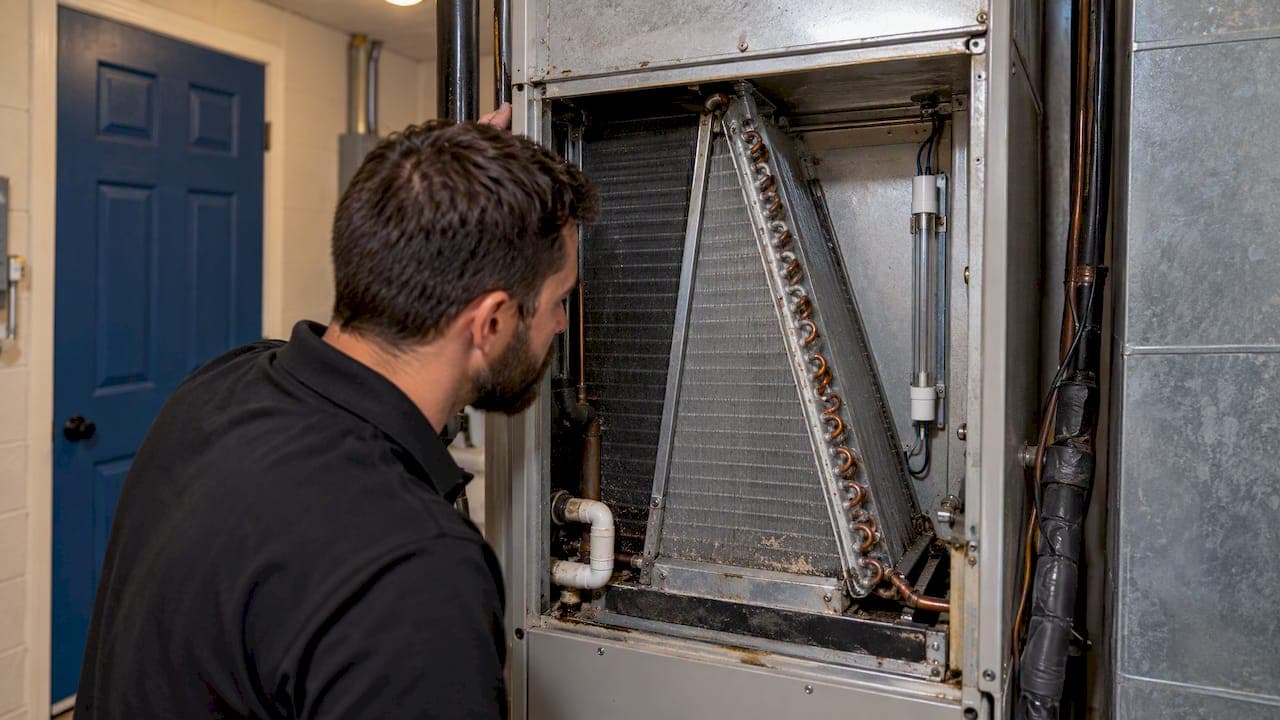
An HVAC UV light can do real good: it inactivates bacteria and mold on the parts of your system it shines on, and it can keep an evaporator coil from growing a slimy film. What it cannot do is clean dust out of your ducts, replace your filter, or deliver the big energy savings some sales pitches promise. Whether it is worth it depends on what problem you are trying to solve. Here is what the research shows, what it costs to own one, and how to decide.
TL;DR
- UV-C lamps in HVAC systems inactivate microorganisms. In EPA lab testing, all nine in-duct devices tested were over 99% efficient against vegetative bacteria, while results against spores and viruses varied.
- Coil-sanitizing lights are the most practical type for a home: they keep mold and biofilm from building on the evaporator coil.
- Claims of big energy savings are thin. An Oak Ridge National Laboratory review found little evidence of significant operating savings.
- UV does nothing about dust, pet hair or debris. Clean ducts, good filters and proper ventilation come first, and UV is an extra layer on top.
- Expect lamp replacement every year or two, and keep exposure safety in mind whenever anyone services the unit.
Table of Contents
- What an HVAC UV light actually does
- Do HVAC UV lights work?
- The real benefits, and how strong the evidence is
- What UV light does not do
- Risks and safety
- What it costs to own one
- Is an HVAC UV light worth it?
- A sensible order of operations
- Our perspective
- Start with a clean system
- FAQ
- Sources
What an HVAC UV light actually does
A UV light for HVAC is a germicidal lamp mounted inside your air handler or ductwork. It gives off UV-C, a short wavelength of ultraviolet that damages the genetic material of microorganisms so they cannot reproduce. That is what "inactivating" means: the microbe is not physically removed, it is rendered unable to grow or infect.
It is not the same as the sunlight that tans skin, and it is not a filter. Nothing is trapped. The lamp simply irradiates whatever passes by or sits in its path.
Manufacturers describe two common types:
- Coil sanitizing lights shine on the evaporator coil, the cold, damp surface where mold and bacteria love to settle.
- Air sanitizing lights sit in the ductwork and treat the air as it moves past.
Engineering literature groups UVGI (ultraviolet germicidal irradiation) in buildings more broadly into in-duct, upper-room and in-room systems. For a typical house with central air, the two that matter are the coil light and the in-duct light. Upper-room and in-room systems are mostly for large, crowded spaces.
Do HVAC UV lights work?
Yes, for the specific job of inactivating microbes that get enough UV exposure. That is the honest short answer, and the caveat is the exposure part.
The strongest data point comes from the EPA. In a laboratory evaluation of in-duct UVC devices, all nine devices tested were over 99% efficient at inactivating vegetative bacteria. Performance against bacterial spores and viruses varied from device to device. Spores are tougher than ordinary bacteria, and some molds produce spores, so a lamp that is great against one organism may be mediocre against another.
Three things decide how well a lamp performs in a real system:
- Dose. Killing a microbe takes a certain amount of UV energy, which is intensity multiplied by time. Air moving fast past a lamp gets a short exposure.
- Lamp condition. Lamps lose output with age and dust blocks light.
- Placement. A lamp aimed at the coil treats the coil. It does little for a dirty return duct three rooms away.
That is why a lab number does not guarantee a result in your attic or utility closet. A properly sized and placed lamp does the job. A cheap, poorly placed one mostly gives you peace of mind.
The real benefits, and how strong the evidence is
The listings that rank for this topic often present five to seven benefits. Some stand up well. Others are stretched. Here they are, sorted by how much support they have.
Cleaner coils and less microbial growth
This is the best-supported benefit. The evaporator coil is cold and wet whenever the AC runs, which is exactly where microbial films form. A lamp pointed at it reduces that growth. A review of the research from Oak Ridge National Laboratory says UV can help reduce microbial growth on coils and inactivate airborne pathogens, which can support a cleaner indoor environment.
Fewer musty odors
If the musty smell when your AC starts comes from growth on the coil, a coil light can help prevent its return. Note the wording: prevent, not cure. A lamp will not remove a smell that has already soaked into dirty ducts or a drain pan. Cleaning comes first, and the lamp helps keep it that way.
Some reduction of airborne germs
Air-treating lamps can inactivate airborne microbes that pass through the lamp's zone. The catch is contact time. In a home system the air moves quickly, so the effect on the air you actually breathe is modest compared with what the lab results suggest. The CDC treats germicidal UV as a supplemental layer alongside ventilation and HEPA filtration, not a replacement for them.
Better airflow and lower energy bills: weak evidence
Several top-ranking pages claim a UV light raises airflow, cuts energy costs and extends system life. The logic is sound: a clean coil moves heat better than a fouled one. But the ORNL review found that studies measuring fan power or heat transfer have not shown especially significant improvements. Where a coil was already fouled, the gain comes from the cleaning, not necessarily from the lamp. Treat any promised percentage savings with suspicion.
If efficiency is your goal, the bigger levers are mechanical: clean coils, clean ducts, a fresh filter and sealed ductwork. We cover that in our look at HVAC cleaning and energy savings and in our guide on key elements of an efficient system.
What UV light does not do
This is where homeowners get disappointed, so it is worth being blunt.
- It does not remove dust, pet dander, pollen or debris. Those are particles, and UV does not capture particles. A filter does.
- It does not clean dirty ducts. If your ducts are caked with construction dust or years of buildup, a lamp will not touch it. In a dusty climate like ours in the West Valley, that buildup is the more common problem. See what typical HVAC contaminants look like in a home.
- It does not remove odors from cooking, smoke or pets. Those are gases and particles, not microbes.
- It does not treat gases and chemicals. VOCs from paint, cleaners and new furniture pass straight through.
- It does not treat parts it cannot see. Light travels in straight lines and shadows are untreated.
The EPA also notes that it does not certify or endorse specific brands or models of air-cleaning devices, including those using UV light. A "certified" or "EPA approved" claim on a box is a red flag.
Risks and safety
UV-C is hazardous to eyes and skin at the wrong exposure, and the CDC lists UV-C exposure risk and environmental constraints among the limitations of germicidal UV. In a properly installed in-duct or coil system the lamp is enclosed in metal, so you are not exposed in normal use. The risk appears when someone opens the access panel with the lamp on. A well-installed system has an interlock or a clear warning label, and anyone working on the unit should switch it off first.
UV can also damage materials. CDC guidance notes that UV-C can cause cosmetic damage to plants and some materials such as wood surfaces or wallpaper if they sit in the disinfection zone. In a closed duct, that matters mainly for plastic and rubber components placed too close to the lamp. Ask your installer what is within range of the light.
A separate point on ozone. Some "air purifier" products produce ozone as a byproduct, and ozone is a lung irritant. The EPA says electronic air cleaners are not currently regulated at the federal level, though California keeps a list of air cleaners certified as ozone-safe. If you consider a combined unit, ask specifically whether it generates ozone.

What it costs to own one
Prices vary by type, home size and installer, so use these as orientation and not a quote.
The CDC offers one useful published benchmark, though for a different application: it estimates the upfront cost of an upper-room GUV system in a 500-square-foot room at roughly $1,500 to $2,500. That is a room-level system, not what you would put in a home air handler, but it shows that professionally designed UV is a real investment and not a $30 gadget.
For a residential in-duct or coil unit, your costs fall into three buckets:
| Cost | What drives it |
|---|---|
| Unit and installation | Coil light or air light, lamp length, one or two lamps, ease of access to your air handler |
| Replacement lamps | UV output fades long before the bulb stops glowing, so lamps are swapped on a schedule |
| Your time | Checking and dusting lamps, plus a service visit to replace them |
On maintenance, the CDC points to annual or twice-yearly lamp replacement and keeping lamps free of dust. Plan for that recurring cost before you buy, because a lamp left in place for years looks fine but does very little. Ask any installer for the lamp part number and replacement interval in writing, and ask what each replacement costs.
Is an HVAC UV light worth it?
It is worth it in specific situations and a poor use of money in others. Run through these.
It makes sense when:
- You have a recurring musty smell or visible growth on the coil or drain pan, and you have already had the system cleaned.
- Someone in the home is sensitive to mold and your AC runs much of the year.
- Your system sits in a humid or poorly ventilated space, where microbial growth is more likely.
- You manage a space with many people and limited ventilation. The CDC suggests considering UV as an additional layer in crowded spaces or where ventilation is limited.
Skip it, or put it second, when:
- Your ducts are dusty or your filter is overdue. Fix those first.
- You are hoping for a lower power bill. The evidence is thin.
- You expect it to stop dust, allergens or smoke.
- You will not replace the lamps on schedule.
A useful rule: spend your first dollar on cleaning and filtration, your second on airflow and sealing, and your third on UV. If you want to see where UV sits among other options, our air quality devices list compares them in plain terms.
A sensible order of operations
- Get the system clean. Ducts, vents and coils carry the dust and debris that UV cannot touch. Our guide on removing pollutants from HVAC systems walks through what that involves.
- Upgrade and change the filter on a regular schedule.
- Check for leaks, moisture and drain problems. UV treats symptoms of a wet system. It cannot fix a clogged drain.
- Test the air if you are unsure what is actually in it. That shows whether you have a microbial problem or a dust one.
- Then decide on UV, and choose coil or in-duct based on what the test and inspection showed.
This order saves money. Many homeowners buy a lamp to solve a dust problem, and it never does.
Our perspective
We clean ducts, vents and dryer vents in Avondale all day, so we see what actually fouls a system in this area: dust, debris, construction residue and the wear of long cooling seasons. In our experience, that physical buildup is the first thing to address, because it restricts airflow and carries the allergens people complain about. A UV lamp does not remove any of it.
That is why we do not push UV as a cure-all. We see it as a good finishing layer for a system that is already clean, particularly where coil growth or musty smells keep coming back. It is a poor substitute for cleaning, and a poor investment if the lamp is never replaced.
If you are weighing one, ask for an inspection first. Know what is in your system, then decide whether a lamp addresses the problem you actually have. We would rather tell you that you need a filter and a duct cleaning than sell you something that does not fit.
— Shaun
Start with a clean system
If you are comparing UV options, the most useful first step is finding out what your system needs. We provide air duct cleaning, air vent cleaning, air filter replacement and air quality testing for homes and businesses in Avondale, Arizona, and we offer flexible scheduling, including after-hours options for commercial clients.
If you want to talk through your system, see our full list of services or start from our main page. For an office, shop or multi-unit property, our commercial air duct cleaning page explains how we work around your hours. For a deeper look at what a sanitizing visit involves, read our piece on HVAC sanitizing and indoor air quality.
FAQ
Do HVAC UV lights really work?
Yes, at inactivating microbes that receive enough UV exposure. In EPA lab tests, all nine in-duct devices were over 99% efficient against vegetative bacteria, though results against spores and viruses varied. Real-world results depend on lamp size, placement and upkeep.
Are UV lights in HVAC worth the money?
They are worth it when you have a mold or odor problem at the coil, or a space with limited ventilation, and you are willing to replace lamps on schedule. They are not worth it if you expect lower energy bills or dust control. Clean ducts and a good filter should come first.
How often do HVAC UV lamps need replacing?
The CDC points to annual or twice-yearly replacement, plus keeping lamps free of dust. Output drops over time even when the bulb still glows, so a lamp that looks fine may no longer be doing its job. Check your manufacturer's interval for your exact model.
Will a UV light lower my energy bill?
Probably not by much. A clean coil does transfer heat better, but an Oak Ridge National Laboratory review found studies measuring fan power or heat transfer have not shown especially significant improvements. Cleaning the coil, ducts and filter is a more reliable way to restore efficiency.
Are HVAC UV lights safe?
In a properly installed, enclosed system, normal use does not expose you to UV-C. The danger is opening the access panel while the lamp is on, since UV-C can harm eyes and skin. Always switch the system off before anyone opens the air handler, and ask your installer to confirm the lamp is shielded.
Sources
- What Is UV Light in HVAC? (Trane)
- Ultraviolet Germicidal Irradiation for Heating, Ventilation and Air Conditioning (Oak Ridge National Laboratory)
- Biological Inactivation Efficiency of HVAC In-Duct UVC Devices (EPA)
- About Germicidal Ultraviolet (GUV) (CDC/NIOSH)
- Upper-Room Ultraviolet Germicidal Irradiation (CDC)
- Indoor Air Filtration fact sheet (EPA)
- Ventilation in Buildings (CDC)