
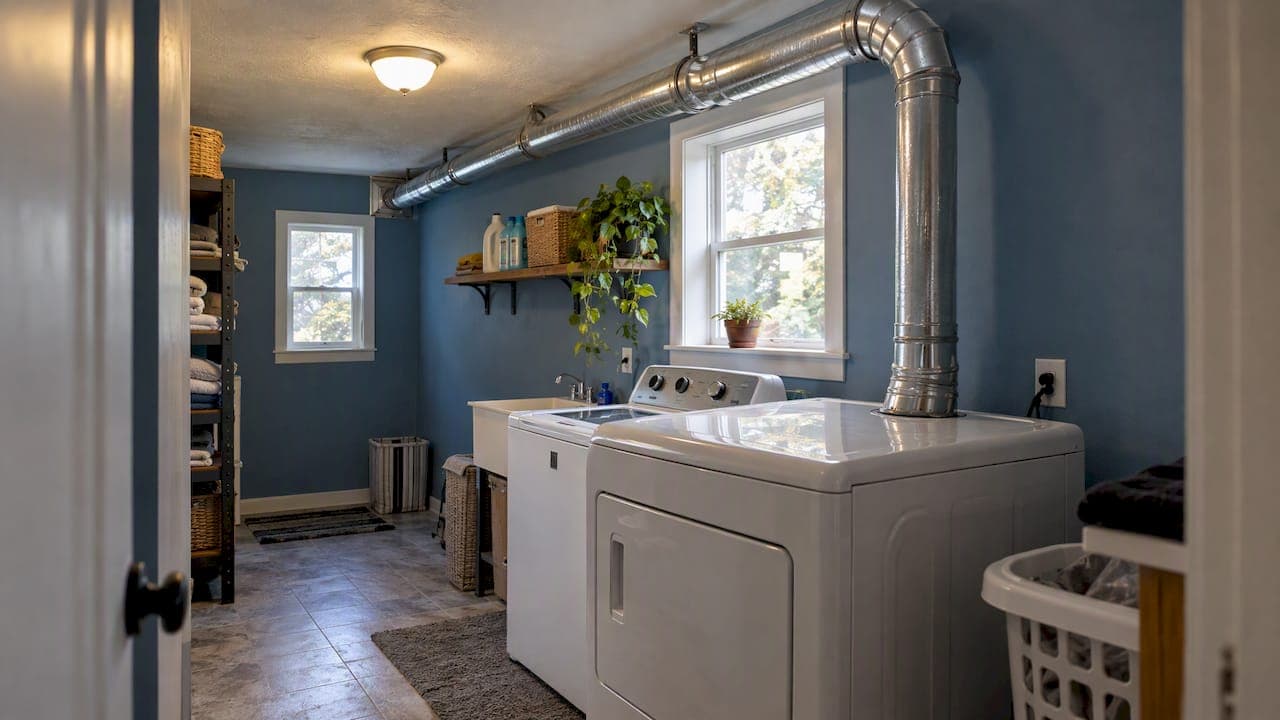
A dryer vent run is too long when your dryer can no longer push air and lint out of the house faster than they build up. The limit is not one number. It comes from your dryer's installation manual, the duct diameter and material, and how many bends the pipe has. A long, straight run of 4-inch metal duct can be fine. A shorter run with four elbows may not be.
This guide shows you how to work out your limit, spot the signs of a run that is too long, fix it, and keep a long vent clean.
TL;DR
- Your dryer's manual sets the maximum vent length. Code defers to it, and bends count against it: each 45-degree bend subtracts 2.5 feet and each 90-degree bend subtracts 5 feet.
- Long drying times, hot clothes, a burning smell or an AF or Check Vent code point to restricted airflow, not necessarily a broken dryer.
- If the run must exceed 35 feet, the U.S. Department of Energy advises a booster fan. Rerouting shorter and straighter is the better first move.
- A long run holds more lint, so it needs professional cleaning at least once a year.
Table of Contents
- What counts as a long dryer vent run
- How to work out the maximum length for your dryer
- Signs your dryer vent is too long
- How to fix a run that is too long
- Cleaning a long dryer vent
- Our perspective: length is only half the story
- Need your long vent checked in Avondale?
- FAQ
- Sources
What counts as a long dryer vent run
The run is the whole path the air takes, from the back of the dryer to the outside termination. That includes the short transition duct behind the machine, the rigid pipe inside the wall, ceiling or crawl space, every elbow, and the hood or cap on the exterior.
People usually call a run "long" in these situations:
- The laundry room is in the middle of the house, so the duct crosses a floor or an attic to reach an exterior wall.
- The dryer sits on a second floor and the vent drops or climbs through several joists.
- The laundry closet is in a hallway with the exterior wall a room away.
- A previous owner extended the vent to move the dryer, and nobody checked the total length.
A vent can be short in feet and still behave like a long one. Every turn adds resistance, and so does a crushed or kinked section.
How to work out the maximum length for your dryer
There are three inputs: the manufacturer's limit, the duct you have, and the bends.
Start with the dryer's installation manual
The manufacturer decides the maximum exhaust length. The model code, the International Residential Code (IRC), defers to the manufacturer's instructions when they permit a longer vent. So the number on your dryer's installation sheet or venting specification page is the number that counts. It is usually listed per duct type and per number of elbows.
You can usually find it by searching your model number plus "installation instructions". If you cannot find a limit, plan conservatively and keep the run as short and straight as you can.
There is a reason these limits exist. Whirlpool's venting specifications say its dryer systems need a minimum duct air velocity of 1,200 feet per minute to keep lint moving, which takes 105 CFM of airflow in a 4-inch pipe. The same document requires a minimum back pressure of -0.1 inches water column, measured at the dryer connection. A longer or more twisted run makes it harder for the dryer's blower to meet those figures.
Use the right duct
The IRC calls for exhaust ducts that are 4 inches in diameter and made of rigid or semi-rigid metal, such as galvanized steel or galvanized aluminum, with a smooth interior. Smooth walls matter because lint snags on ribs. Plastic or foil accordion ducting inside walls restricts airflow and collects lint, and it undermines any length calculation.
The flexible transition duct between the dryer and the wall is the exception, but it is limited. It must not exceed 8 feet and must be listed to UL 2158A. Don't use that flexible piece to cover long distances.
Also check how sections are joined. The same guidance says screws or similar fasteners that protrude into the duct must not be used, because they catch lint. Foil tape or clamps are the usual alternatives. Our guide to dryer vent code requirements and the 4-inch duct rule covers the rest of the checklist.

Subtract for every bend
This is where most long runs go wrong. The IRC method counts elbows against your allowed length: 2.5 feet for each 45-degree bend and 5 feet for each 90-degree bend.
Here is a worked example. Say your manual allows a total of 35 feet for rigid 4-inch duct (this figure is only an illustration, so use your own). Your vent leaves the dryer, makes a 90-degree turn up into the ceiling, runs across, then makes another 90-degree turn out through the wall and one 45-degree jog around a beam.
| Item | Count | Deduction |
|---|---|---|
| 90-degree elbows | 2 | 10 ft |
| 45-degree elbow | 1 | 2.5 ft |
| Total deducted | 12.5 ft | |
| Straight duct you can use | 22.5 ft |
If you measure 26 feet of straight pipe, you are 3.5 feet over, even though the pipe is shorter than 35 feet. Measure the straight sections, add the deductions to get the equivalent length, and compare it with the manual.
Check for the label
When a vent's equivalent length passes 35 feet, code calls for a permanent label or tag showing the length within 6 feet of the duct connection. If you have a long run and no tag, that is a clue nobody calculated it. A general home inspection typically doesn't verify compliance with the manufacturer's length limit, so a clean inspection report is no proof your run is fine.
Signs your dryer vent is too long
A run that is too long or too restrictive tends to show up in the dryer's behavior first. Building America guidance lists these signs:
- Clothes still damp after a normal cycle
- Drying times that keep getting longer
- Clothes or the dryer itself getting too hot
- A burning smell
Some dryers also tell you. Whirlpool says an AF or Check Vent code means the lint screen or vent is clogged, crushed, kinked or has too many turns. Other brands use their own wording, so check your manual.
The stakes go beyond slow laundry. Excess length reduces airflow and contributes to lint buildup, which creates a fire hazard and lowers efficiency, according to the same guidance. The Department of Energy says a properly vented dryer runs more efficiently, is safer and lasts longer. For a fuller checklist of warning signs, see our dryer vent fire checks.
A quick test at home
Turn the dryer on and go outside to the vent hood. You should feel a strong, steady stream of warm air and see the flap open fully. Weak airflow, a flap that barely moves, or lint around the hood all suggest a restriction. Check also whether the cap is blocked by a nest, snow-free debris or lint. If airflow is weak, stop using the dryer for long cycles until the vent is inspected.
What about moisture in the vent?
A dryer exhausts warm, humid air, so some moisture in the duct is normal. A vent that drips or feels wet usually means the humid air is cooling and condensing before it exits, or it is not leaving fast enough. A long run through an unconditioned space is a plausible contributor, as is a restriction. If you see water or damp lint, have the run inspected rather than assuming it is harmless, because damp lint packs tightly and holds more weight in the duct.
How to fix a run that is too long
The approach below follows the order that Building America guidance recommends: shorten first, boost only if you must.
- Reroute to a shorter, straighter path. The guidance advises making the vent shorter, straighter and horizontal where possible. Moving a single 90-degree elbow can give back 5 feet of allowance.
- Swap out flexible duct. Replace foil or vinyl duct with smooth rigid metal, using the right transition piece only for the final connection to the dryer.
- Remove unnecessary bends. A vent that wanders around obstacles can sometimes be redrawn to exit through the nearest exterior wall.
- Consider a different exit. Some homes can terminate through a different wall. That is a construction decision, so a contractor should confirm it.
- Add a booster fan if the route can't change. If the run must exceed 35 feet, the Department of Energy says to install a booster fan. Building America guidance also recommends one for long or upward-angled routes.
Booster fans: what to know first
A booster, or inline, fan assists airflow in the duct. Use one rated for dryers, and check that your dryer's manual does not forbid it. Some manufacturers have conditions. A booster also needs power and its own maintenance, and it can fail. That is why shortening comes first.
For multi-dryer systems, such as in an apartment building, the rules differ. Whirlpool says that when an AF code indicates excessive back pressure in a shared system, the engineering firm that designed the system should be consulted. Do not tinker with a shared riser on your own.
When to call a pro
Call a professional if you have a gas dryer, a vent that goes through a roof, a run through attic or crawl space you can't safely reach, or a vent you can't trace. Gas dryers add a combustion exhaust, so poor venting is more serious. Roof terminations have their own failure points, covered in our dryer vent roof problems guide.
Cleaning a long dryer vent
Cleaning does not fix a run that is too long by design, but it does stop it from getting worse. More duct means more surface for lint to settle on, so long runs fill faster and are harder to clear with a household brush.
The guidance is to have a professional technician clean the exhaust duct at least once a year. Whirlpool's wording is slightly looser: every one to two years, or sooner when drying performance drops. For a long or bend-heavy vent, treat annual as the minimum. Our article on dryer vent cleaning frequency explains how to adjust for a big family or heavy laundry use.

Why do long runs need a pro? A short brush kit reaches only the first few feet. Homeowners who try the DIY route often add rod extensions and a drill, and still can't tell what is left at the far end, past a turn. A technician uses powered brushes and a vacuum, and can confirm airflow at the exterior afterward. Read more about what causes dryer vent blockages and why removing lint matters for safety and efficiency.
Keep a long run healthy between cleanings
- Clean the lint screen before every load.
- Wash the screen occasionally with soap and water if fabric softener has left a film.
- Keep the outdoor hood clear of debris and make sure the flap moves freely.
- Don't squeeze the dryer against the wall in a way that crushes the transition duct.
- Don't run the dryer when you notice a burning smell. Unplug it or shut off the gas and get it checked.
Our perspective: length is only half the story
We clean dryer vents in Avondale, and the pattern we see is that people ask about maximum length when the real problem is condition. A run that was fine on paper when the house was built can become a problem after years of lint, a crushed section behind the dryer, or a bird nest in the hood. The reverse happens too: a long vent with smooth metal and few bends, cleaned every year, can work well.
Our advice is practical. Find your manual's limit, count the elbows, and be honest about whether the pipe is rigid metal or foil. If the numbers work, keep the vent cleaned on a schedule. If they don't, shorten the route before adding equipment, and use a booster fan as the answer for routes that can't change. Whatever you choose, have the vent cleaned first so you can tell whether the problem is length or buildup. A dryer that suddenly struggles is more often clogged than too long.
— Shaun
Need your long vent checked in Avondale?
If your dryer takes two cycles to finish or the vent has more turns than you can count, our team can clean the whole run and tell you what we find. Learn more about dryer vent cleaning in Avondale, AZ or ask about ductwork repairs and related services. We serve homes and commercial properties, and we offer warranties on our services and flexible scheduling, including after-hours options for businesses.
FAQ
What is the maximum length of a dryer vent?
There is no single answer. The dryer manufacturer's instructions set the limit, and the code defers to them. Each bend then reduces what you can use, by 2.5 feet for a 45-degree elbow and 5 feet for a 90-degree elbow. If the run will exceed 35 feet, the Department of Energy advises a booster fan.
Can a dryer vent that is too long cause a fire?
It can contribute. Excess length reduces airflow and lets lint build up, which is a fire hazard according to Building America guidance. The risk grows when the vent is not cleaned regularly, so long runs need annual professional cleaning.
Does a longer vent make clothes take longer to dry?
Yes, if the length or number of bends restricts airflow. Damp clothes, long cycles, overheated clothes or a burning smell are typical signs. Some dryers show an AF or Check Vent code. Clean the vent and check the outlet hood before assuming the dryer is faulty.
Can I use flexible duct to run the vent a long way?
No. Flexible transition duct is limited to 8 feet and must be UL 2158A listed, and it is meant only for the connection at the dryer. The main run should be 4-inch rigid or semi-rigid metal with a smooth interior.
How often should a long dryer vent be cleaned?
At least once a year by a professional. Manufacturers say every one to two years or when drying performance drops, but a long or bend-heavy vent collects lint faster, so don't stretch the interval.
Sources
- Proper Clothes Dryer Venting, Building America Solution Center
- Vent a Clothes Dryer, U.S. Department of Energy
- Dryer Venting Specifications, Whirlpool
- Long Dry Times, Dryer Product Help, Whirlpool
- Domestic Clothes Dryer Ducts, UpCodes
- Dryer Vent Safety, InterNACHI