
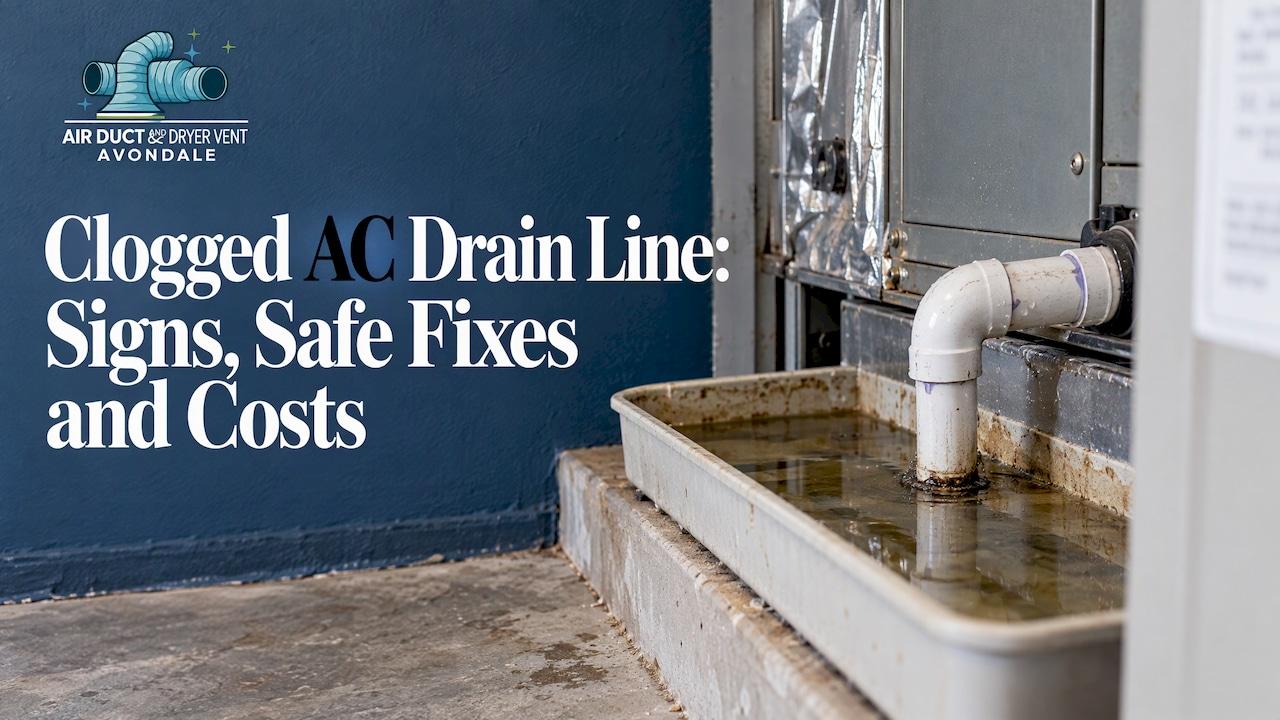
If your air conditioner is leaking water inside the house, a clogged condensate drain line is the first thing to suspect. One HVAC company calls it the most common cause of water leaking from an AC into the home. Turn the system off at the thermostat, soak up the standing water, and then work through the checks below. If the leak is large, near electrical parts or keeps coming back, call a licensed HVAC technician.
TL;DR
- Your AC pulls moisture out of the air, and that water leaves through a small drain line. When algae, mold or dust block it, water backs up and spills indoors.
- Typical signs: a puddle near the indoor unit, a musty smell, a tripped float switch that shuts the system down, and no dripping at the outdoor drain outlet.
- Turn the AC off first. Suction from a wet/dry vacuum at the outdoor end is the safest do-it-yourself step. Skip bleach, high-pressure air and household vacuums.
- Professional drain line cleaning in the US averages $75 to $250. Repeated clogs usually point to a bigger problem.
- In Avondale, call us if the leak is large, the clog returns or you see mold. We handle AC repair and duct cleaning for homes and businesses.
Table of Contents
- Why a clogged drain line makes your AC leak inside
- Signs your AC drain line is clogged
- Is it the drain line or something else?
- What to do the moment you see water
- How to clear the line safely
- When to call a technician
- What professional drain line cleaning costs
- How to keep the line from clogging again
- Our perspective
- Get help in Avondale
- FAQ
- Sources
Why a clogged drain line makes your AC leak inside
When warm air passes over the evaporator coil, moisture condenses into water. According to Daikin, that water drips into a drain pan and flows into the drain line. If the line clogs, the water backs up into the pan and can spill onto ceilings, walls or floors.
The line itself is simple. It is usually a 3/4-inch PVC pipe that carries water from the pan under the evaporator coil to the outside of the home or to a floor drain. Because it is narrow, it does not take much to block it.

Condensation is normal. Leaking is not. A Haha's Heating and Cooling guide explains that the amount of water depends on indoor humidity, runtime, airflow, coil temperature, system size and outdoor weather. That matters in the Phoenix area, where air conditioners run hard for much of the year. One contractor estimates that a typical residential system can produce 5 to 20 gallons of condensate a day in humid conditions. Even when the air is drier, a blocked line leaves that water nowhere to go.
How the clog builds
Clogs do not appear overnight. Daikin notes that they build gradually from dust and dirt, mold, algae and debris. A dark, damp pipe is ideal for mold and algae, which can form slimy layers that shrink the pipe's usable diameter.
Airborne dust is the raw material. The more dust circulating through your system, the more ends up in the pan and the line. If you want to see how that dust accumulates, read about why air vents get dusty and what to do about it. We also cover what causes duct contaminants in your home on our blog.
Installation matters too. Chris Reading of Roy's Heating, Cooling, Plumbing & Electrical says clogs usually come from mold growth, dust, rust, or improper installation such as a line that is not sloped correctly.
Signs your AC drain line is clogged
Most people notice water first. Look for these signs, which several manufacturers and HVAC companies list:
- Musty or moldy smell from the indoor unit or the vents. Carrier lists this along with standing water near the indoor unit, water damage on ceilings or floors, loss of cooling and system shutdown.
- Water in the drain pan or a puddle by the indoor unit. 602 HVAC adds that a float switch shutting the system down, or no water at the outdoor outlet on a hot day, are typical signs.
- Gurgling near the drain, stains on walls or ceilings, or a tripped float switch. TLS Energy Savers includes these in its list of warning signs.
- A blank thermostat. If the float switch cuts low-voltage power, homeowners often think the thermostat failed when the real cause is water backing up in the drain system.
If your unit sits in the attic, there may be a secondary drain that exits outside near a sidewalk or doorway. Carrier says excess water coming from that emergency line is usually a sign of a problem, and the system may stop cooling because a safety switch shuts it down when the pan fills.
Is it the drain line or something else?
A clog is the usual suspect, but not the only one. Trane lists four main causes of an indoor central AC leak: a damaged drain pan, a clogged condensate line, a frozen evaporator coil or a damaged condenser.
| Symptom | Likely cause | What to do |
|---|---|---|
| Puddle under the indoor unit, no water at outdoor outlet | Clogged drain line or full pan | Turn off AC, try suction at the outdoor end |
| Ice on the coil or refrigerant lines | Poor airflow or low refrigerant | Turn off AC, replace a dirty filter, call a technician if ice returns |
| Water around the unit, rusty or cracked pan | Damaged drain pan | Call a technician |
| System shuts off, thermostat blank | Tripped float switch | Check the drain line, then call if it does not restart |
The ice versus puddle distinction comes from 602 HVAC: a puddle under the indoor unit points to a clogged line or full pan, while ice points to poor airflow or low refrigerant.
Bryant suggests a three-check method: check the air filter, check the condensate drain line for blockage, and check the evaporator coil for freezing. A dirty filter restricts airflow and can contribute to a frozen coil. Bryant recommends replacing filters about every one to three months.
Sitton Mechanical reports that frozen coils account for about 25% of its leak calls, and failed pans, pumps or traps for about 15%. That is one company's call mix, not a national figure, but it shows how many leaks have nothing to do with the line.
What to do the moment you see water
- Turn the AC off at the thermostat, and at the breaker if water is near electrical parts. AirShield HVAC advises not restarting it until the cause is identified.
- Contain the water. Move valuables and soak up standing water with towels or a wet/dry vacuum.
- Check the filter. Replace it if it is clogged.
- Look for ice on the coil or refrigerant lines.
- Check the drain line only if it is safely accessible.
Do not keep running the system. AirShield warns that continued operation can lead to severe water damage, mold growth, ruined drywall and electrical hazards if water reaches live wires. Stop troubleshooting and call a professional if water is dripping near your electrical panel, thermostat or main light fixtures, or if dark stains are spreading across ceiling drywall.
How to clear the line safely
The method most sources agree on is suction. Today's Homeowner outlines these steps:
- Turn off the system.
- Attach a wet/dry vacuum to the outdoor end of the drain line and run it for one to two minutes.
- For a stubborn clog, use a small flexible brush or a drain snake.
- Pour in about 1/4 cup of distilled white vinegar, wait 30 minutes, then flush with about half a gallon of warm water.
Chadwell Supply gives a similar routine: cut power, empty the secondary pan with a wet/dry vacuum after removing its paper filter, run the vacuum on the exterior discharge for 2 minutes, then check water flow. If the blockage remains, a Gallo Drain Gun uses a burst of pressurized air without heavy tanks.
One caution on that last tool: pressure is where homeowners get into trouble, as explained below. A Trouble Free Inc. guide says suctioning the outdoor end works on about half of clogs and buys time while you wait for service. If water flows freely afterward, you are done for now. If not, stop and call.
What to avoid
- Bleach. Today's Homeowner notes that most HVAC professionals do not recommend it because it can damage PVC. ACHR News reports that manufacturers no longer recommend pouring chlorine bleach into a drain line, because it can quickly eat away at PVC, the cement at the fittings and the condensate pan.
- Drain cleaners and caustic chemicals. Precision Air says not to use them unless the equipment manufacturer and an HVAC professional approve.
- High-pressure compressed air. The same source warns it can separate PVC fittings, blow debris into the pan or create a leak inside a wall or attic.
- A household or carpet vacuum. Top Tech Mechanical explains these are built for dry debris, and drawing water through one creates a shock hazard and destroys the motor.
- A plumber's snake. On 3/4-inch condensate lines it catches at the first elbow, and forcing past it can split the fitting.
Top Tech Mechanical puts the risk plainly: applied at the wrong point, pressure pushes water back across the evaporator coil, and applied at the wrong force it can separate glued joints inside a wall, turning a 20-minute job into drywall repair.
When to call a technician
Call a licensed HVAC technician if any of these apply, based on Today's Homeowner's list:
- The clog persists after you clear it.
- You see a frozen coil, water damage, mold or mildew.
- The drain pan is rusty or the float switch malfunctions.
- The system will not restart after clearing.
- You are not comfortable handling HVAC components or lack a shop vacuum or small brush.
Hartzell's adds pooling water, water dripping from ceiling vents, ice on refrigerant lines and repeated clogs to the list.
Repeat clogs deserve attention. Precision Air points out that a line that keeps clogging often signals a larger issue, such as poor slope, a damaged trap, missing insulation or contamination in the pan. A dirty evaporator coil, excess airborne dust or biological growth deeper in the system can cause the same pattern.
If you manage a restaurant, office or retail space, do not wait for a visible leak. Precision Air notes that backups can affect ceiling tiles, inventory, electrical components and customer areas.
What professional drain line cleaning costs
In the United States, drain line cleaning averages $75 to $250 to unclog and flush the condensate line. Wright Home Services gives the same range, depending on the clog's severity, whether it is part of routine maintenance and whether other AC repairs are needed. Many companies include cleaning in an annual tune-up at no extra charge.
Add-ons raise the bill. A Baltimore-area contractor puts cleaning at $100 to $250, and about $185 to $350 once you add a cleanout tee, a new float switch or PVC repair. Emergency after-hours service there runs $250 to $350. Prices vary by region and company, so treat these as benchmarks. We do not publish set prices for our services; contact us for a quote for your property.

Compare that with a ceiling repair. Since a system can generate gallons of water a day, a few hours of neglect can cost far more than a service visit.
How to keep the line from clogging again
- Flush on a schedule. Today's Homeowner suggests flushing every one to three months depending on AC use, checking monthly in heavy-use season and quarterly otherwise, and scheduling annual HVAC maintenance. Hartzell's says drains should be checked during routine maintenance, typically twice a year.
- Change filters. ACHR News explains that regular filter changes limit the dirt that reaches the condensate water. A filter rated MERV 8 or higher, or a whole-house air cleaner, can limit particles further.
- Check the cleanout and float switch whenever you change the filter. Chadwell Supply recommends this, since without a properly installed shut-off switch the pan may overflow and damage nearby areas or the system.
- Keep the ducts and air handler clean. Less dust in the airstream means less sludge in the pan. Our posts on HVAC mold prevention and mold in HVAC systems go deeper.
If your AC smells like mildew, our guide on safe checks for AC mildew smells is a good next step. Water that appears on ductwork rather than at the unit is a different issue, covered in our air duct condensation article.
Our perspective
Most water leaks we hear about have a simple story: a small pipe, a little slime, and a system that nobody looked at until the ceiling stained. The clog is the symptom. The dust, mold and buildup that feed it are the cause.
That is why we treat HVAC cleaning as our specialty, not an add-on. We use commercial-grade equipment, our technicians are trained for this work, and our services come with warranties. We offer flexible scheduling, including after-hours options, because a leaking system rarely picks a convenient time, and businesses cannot close the doors to wait for a repair.
Our advice to Avondale homeowners and property managers: shut the system off, contain the water, and do not force anything. A clean system, a fresh filter and a drain line that is looked at on a schedule save far more than they cost. When a clog keeps returning, have someone look at the whole system, not only the pipe.
Shaun
Get help in Avondale
If your AC is leaking, or you want to stop it before it starts, we can help. Our A/C repair and heating service covers diagnosing the problem, and our team works with homes and commercial properties across Avondale, Arizona.
If dust and buildup are behind your recurring clogs, air duct cleaning removes dust, allergens, mold and debris from the system. Business owners can ask about commercial air duct cleaning, and you can ask about bundled discounts when you book more than one service. Visit our home page to request a visit.
FAQ
Why is my air conditioner leaking water inside the house?
The most common cause is a clogged condensate drain line, where algae, mold, dust or sludge block the pipe and water backs up. Other causes include a damaged drain pan, a frozen evaporator coil or a damaged condenser, as Trane lists. Turn the unit off and check the filter, the coil and the drain line.
Can I run my AC if it is leaking water?
No. Continued operation can cause water damage, mold growth and electrical hazards, according to AirShield HVAC. Keep it off until the cause is found and fixed.
How often should I flush the AC drain line?
Today's Homeowner suggests every one to three months, depending on how much you use the AC, plus annual professional maintenance. In long cooling seasons, lean toward the shorter interval.
How much does it cost to have an AC drain line cleaned?
The US average is $75 to $250. Extra repairs such as a new float switch or PVC work raise the total. Contact us for a quote on your system.
Is it safe to pour bleach down the AC drain line?
No. ACHR News reports that bleach can eat away at PVC pipe, the glue at the joints and the condensate pan. Distilled white vinegar is the gentler option HVAC guides suggest.
Sources
- Understanding AC drain lines (Daikin)
- Why is my home air conditioner leaking water inside? (Cool Today)
- AC leaking water inside (Texas Temp Masters)
- Condensate drainage and water leaks (Haha's)
- AC drain line clogged (Today's Homeowner)
- How to clean AC drain line (Carrier)
- AC leaking water (602 HVAC)
- Air conditioner leaking water (TLS Energy Savers)
- AC leaking water (Trane)
- Why is my AC leaking water? (Bryant)
- Why is my AC leaking water inside? (Sitton Mechanical)
- AC leaking water emergency (AirShield HVAC)
- Clearing a clogged HVAC drain line (Chadwell Supply)
- AC leaking water inside (Trouble Free Inc.)
- Ensuring proper condensate drain management (ACHR News)
- How to clean AC drain line safely (Precision Air)
- AC drain line clogged (Top Tech Mechanical)
- Why is my AC leaking water? (Hartzell's)
- Condensate drain crisis (Complete Climate Services)
- How much does drain cleaning cost? (HomeGuide)
- How much does it cost to flush an AC drain line? (Wright)
- Dusty air vents