
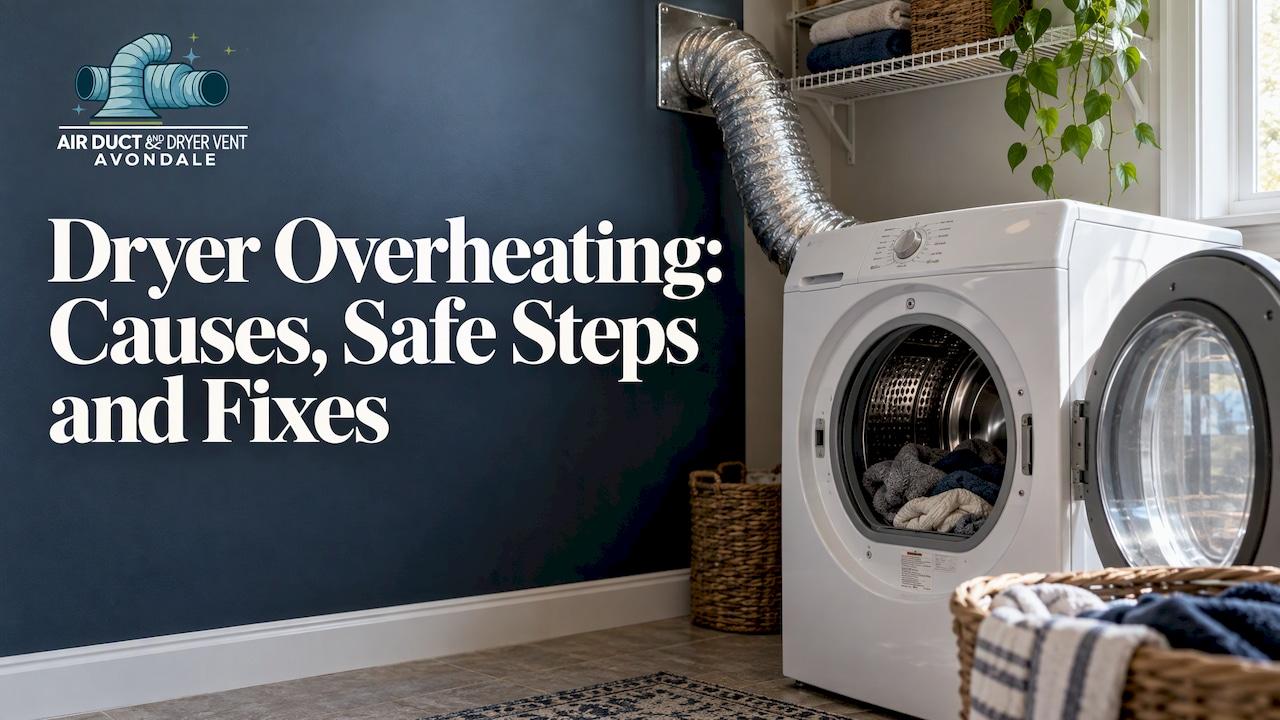
A dryer that runs too hot is almost always a dryer that cannot push its hot, damp air out of the house. Lint in the screen, the transition hose or the vent line is the usual reason. Stop the cycle, let the machine cool, and clear the airflow path before you run another load. If it still overheats, or you smell burning, stop using it and bring in a qualified technician.
This guide covers what overheating looks like, why it happens, what to do in the first ten minutes, how to check airflow without taking anything apart, and how to keep it from coming back.
TL;DR
- Restricted airflow is the most common reason a dryer gets too hot: a full lint screen, a crushed hose or a lint-packed vent line.
- Warning signs include a hot cabinet, clothes too hot to handle, long dry times, a burning smell, or the dryer shutting off mid-cycle.
- If you suspect overheating, stop the dryer, unplug it, and call emergency services for smoke, a strong burning odor or suspected lint ignition.
- Clean the lint screen after every load and have the whole vent system cleaned at least once a year, or sooner if dry times grow.
- If the dryer still runs hot after the vent is clear, the thermostat, blower or heating element needs a qualified technician.
Table of Contents
- What dryer overheating looks like
- Why a dryer overheats
- What to do right now if your dryer overheats
- How to check airflow without taking the dryer apart
- Why it matters: the fire numbers
- Prevention that actually works
- Special cases for landlords, managers and businesses
- When to call a technician
- Our perspective
- Get your dryer vent cleaned in Avondale
- FAQ
- Sources
What dryer overheating looks like
A dryer is supposed to be hot. Maytag says the exhaust of a properly working dryer shouldn't exceed 200°F. Trouble starts when the machine holds that heat inside instead of venting it.
Watch for these signs:
- The cabinet or top panel is hot to the touch. Maytag notes that a hot outside or clothes too hot to take out after a cycle can mean the appliance needs maintenance.
- Clothes come out scorching but still damp. Heat is high, but moisture has nowhere to go.
- Dry times keep growing. Consumer Reports engineer Richard Handel lists longer drying, very hot clothes and unexpected shutdowns as signs of a malfunction.
- The dryer stops before the cycle ends. Many dryers shut themselves off when they detect too much heat.
- A burning smell or scorched fabric. Treat this as urgent, not as a quirk.
- Moisture where it should not be. Whirlpool lists steam, water dripping on the floor, no lint on the screen and no air movement among the signs of a restricted vent. A missing lint layer on the screen sounds odd, but it can mean air is not moving through.
The same blockage can also make a dryer fail to heat. Maytag points out that a lint-clogged vent duct can be why a dryer isn't heating as well as why it overheats. So "too hot" and "not drying" are often one problem seen from two sides.
Why a dryer overheats
Think of the dryer as a heater and a fan working together. The heater warms the air, the blower pulls it through the drum, and the vent carries the moisture outside. If the exit is blocked, the heater keeps going but the heat has nowhere to travel. Temperatures climb, and the dryer's safety devices start tripping.
Restricted airflow: the number one cause
Maytag names a clogged exhaust vent, an uncleaned lint trap and a crushed dryer duct among five common causes. Look at each point along the air path:
- The lint screen. A film or clogged mesh blocks air even when it looks clean. Hot water, mild soap and a nylon brush clear it, which is what AHAM recommends doing occasionally.
- The transition hose behind the dryer. The short duct between the machine and the wall gets pinched when the dryer is pushed back. A kink can cut airflow sharply.
- The vent line inside the wall, ceiling or crawlspace. Lint builds up here where you cannot see it. Long runs and many elbows make it worse. Whirlpool says many dryers perform best with total equivalent vent lengths under 35 feet, and each 90-degree elbow adds resistance. Check your model's installation instructions for exact limits.
- The exterior vent cap. A flap that does not open fully, or one packed with lint, traps air.
- The cabinet interior. Lint also collects around the blower and heating components inside the dryer.
The U.S. Consumer Product Safety Commission's staff report found that lint begins accumulating from the first uses of a dryer, even when it is installed to manufacturer instructions, properly exhausted, and the screen is cleaned between loads. That is why a vent that was fine at move-in does not stay fine.
Material of the duct matters
Whirlpool recommends rigid or semi-rigid metal venting and advises avoiding plastic or foil accordion-style ducts. Ribbed ducts snag lint and crush easily. If you see one behind your dryer, replacing it is a sensible upgrade.

Parts that fail
When the airflow path is clear and the dryer still runs hot, a component may be at fault:
- Cycling thermostat. It turns the heat off and on. If it fails, the heater can run too long.
- High-limit thermostat. This is the safety device. AllSafe Appliances explains that it monitors internal temperature and shuts the dryer down if it overheats, and because it is part of the electrical safety system, professional diagnosis is recommended when it fails.
- Blower wheel. A damaged or lint-covered wheel moves less air.
- Heating element. In electric dryers, an element can short against its housing.
These repairs involve electrical parts and sometimes gas connections. Leave them to a qualified appliance technician.
What to do right now if your dryer overheats
Do these in order:
- Stop the cycle and unplug the dryer. If it is a gas dryer and you smell gas, leave the house and call your gas utility or 911.
- Call 911 for smoke, a strong burning odor or any sign lint has ignited. Do not open a hot drum to investigate if you see smoke.
- Let it cool. Do not restart it while it is still hot. Repeated shutdowns point to an airflow or temperature-control problem, so do not keep rerunning the load.
- Remove the clothes carefully and spread them out. Hot, damp piles are not something to leave sitting.
- Clean the lint screen and wipe the housing around it.
- Check the hose and the outside vent cap (see the next section).
- Run one short test cycle only after the basics are cleared, and stay home while it runs.
- Stop using it and call for service if it still overheats, smells burnt or shuts off again.
The Colorado Springs Fire Department adds two habits worth copying: turn the dryer off when you leave the house or go to bed, and do not overload it.
How to check airflow without taking the dryer apart
You can test the vent path in about five minutes:
- Feel the exterior vent. Run the dryer on a heated cycle and go outside. Whirlpool says weak airflow at the exterior means the vent path may be restricted. You should feel a steady push of warm air and see the flap open fully.
- Look at the vent cap. Lint hanging from the flap, a stuck flap or a bird nest tells you the exit is compromised.
- Check the door seal and lint housing. Visible lint around them is another airflow warning sign, along with loads that are warm but damp after a full cycle.
- Notice the laundry room. Extra heat or humidity there suggests exhaust is leaking out instead of leaving the house.
- Look behind the dryer. Pull it out gently, with power unplugged, and see whether the hose is crushed or disconnected.
Do not rely on a built-in alert alone. GE says a Check Vent alert should prompt immediate cleaning, and that the vent should be cleaned at least once a year even without it. Consumer Reports testing found that some sensors detect a completely blocked vent well but are not as good with partial blockages, which are the common case.
Our own guide on dryer vent fire checks walks through what to look for from both inside and outside the home. If you see water at the vent, read what to check for a dripping dryer vent.
Why it matters: the fire numbers
Overheating is a performance problem first and a safety problem soon after. The National Park Service, citing CPSC data, reports about 15,500 clothes dryer fires each year in the U.S., with an average of 10 deaths, 310 injuries and more than $84 million in property damage. The Colorado Springs Fire Department puts failure to clean as the leading cause.

The CPSC staff report notes that NFPA data found "lack of maintenance" to be the leading cause, with dust, lint and fibers the first material ignited in almost 28 percent of fires. Different agencies count differently, so treat the figures as a picture of scale rather than a forecast for your home. The takeaway is the same in each: lint plus heat plus poor airflow is the risk, and cleaning is the remedy.
Prevention that actually works
Every load
- Clean the lint screen.
- Do not overload the drum.
- Keep the area around the dryer clear of clutter.
Every few months
- Wash the lint screen with hot soapy water and a nylon brush.
- Clean the back of the dryer and the floor under and behind it.
- Check the exterior flap opens freely.
Every year
- Have the interior and the full vent system cleaned. AHAM recommends a qualified technician clean the appliance interior and venting once a year and a thorough vent cleaning whenever drying times increase. Consumer Reports and GE also say annually.
- Have gas dryers inspected by a professional so the gas line and connection are intact and free of leaks.
Maytag's guidance is at least every two years for the whole ventilation system, and Whirlpool says every one to two years or as needed when performance drops. A family that does several loads a week, or a home with a long vent run, should be on the shorter end. We explain how to pick your interval in annual dryer vent cleaning rules for homeowners and landlords.
What never goes in with heat
AHAM warns that no washer can completely remove flammable liquids from fabrics, and they can ignite or explode in a dryer. Items with foam, rubber or plastic, or other heat-sensitive materials, need to be line-dried or run on an air-only cycle with no heat.
Special cases for landlords, managers and businesses
Shared and heavy-use dryers build lint faster than a single household's machine. If you manage rental units, the vent in each one is your responsibility to keep safe. Our safety guide to dryer vent cleaning in apartments covers the checks. Venting that travels through an attic is harder to inspect, which we cover in attic dryer vent risks. Laundromats and facilities with commercial machines face the same physics at higher volume: see why laundromats need dryer vent service and why commercial dryers need frequent cleaning.
When to call a technician
Call someone when the situation matches one of these:
| Situation | Who to call |
|---|---|
| Smoke, strong burning smell, suspected lint ignition | 911 |
| Dryer runs hot, and airflow outside the house is weak or the vent is long or crushed | Dryer vent cleaning specialist |
| Dry times still long after you cleaned the screen and hose | Vent cleaning first, then appliance service |
| Error codes, no heat, unusual noises, repeated shutoffs after the vent is clear | Qualified appliance technician |
| Suspected failed thermostat, blower or heating element | Qualified appliance technician |
| Gas dryer, any gas smell or yearly check | Gas utility or licensed professional |
Whirlpool advises arranging service if long dry times persist after cleaning, the dryer does not heat, error codes display or unusual noises occur. Because the vent is the most common cause, cleaning it first usually answers the question or rules it out before you pay for parts.
Our perspective
In our work, the overheating call nearly always starts with the same story: the dryer used to be fine, then dry times crept up, then one day the cabinet was too hot to touch. That slow slide is exactly why we treat vent cleaning as its own specialty and not an add-on to something else.
What we see as the real fix is the entire path, not just the lint screen. A hose that is clean but crushed, a duct that is clean but made of foil, or an exterior cap that does not open will bring the problem back. Our approach is to clean the whole run from the dryer to the outside, using commercial-grade equipment and trained technicians, and to stand behind the work with a warranty on our services.
If you own a home in Avondale, put a yearly vent cleaning on the calendar and do not wait for the symptoms. If you manage rentals or a business, the same applies, and we offer flexible scheduling, including after-hours for commercial clients, so laundry does not have to stop for the service.
Shaun
Get your dryer vent cleaned in Avondale
If your dryer is running hot and the lint screen and hose are clear, the vent line is the next place to look. We clean dryer vents for homes and commercial properties in Avondale, AZ, and our technicians clear the full run, not only the part you can reach. Our dryer vent cleaning service is where to book.
We also handle related work that comes up when a vent is damaged or poorly built: air vent replacement, air duct cleaning for your HVAC system, and A/C repair. Ask about bundled discounts when you combine services. If the dryer itself has a failed part, we will tell you to bring in an appliance technician for the repair.
FAQ
What happens if my dryer overheats?
The dryer may shut off mid-cycle, clothes can scorch or shrink, and parts such as the heating element can wear out early. Worse, lint in a hot, restricted vent can ignite. Stop the dryer, unplug it, and call 911 if you notice smoke or a strong burning smell.
How long does it take a dryer to cool down after overheating?
No official source gives a fixed time, and it depends on the model and how hot it got. Let it rest until the cabinet and drum are no longer hot to the touch before you handle it or restart it. If it shuts off again, stop using it and have the vent and parts checked.
Why is my new dryer getting too hot?
A new dryer is usually fine, so look at the venting it is connected to. An old, crushed, plastic or foil duct, or a long run with many elbows, can restrict airflow even with a brand-new machine. Check your installation instructions for vent limits and have the vent cleaned or corrected.
Is it safe to keep using a dryer that runs hot?
No. Stop using it until the lint screen, hose and vent are cleared and the cause is addressed. If it still runs hot after that, have a qualified technician diagnose it before you use it again.
How often should I clean my dryer vent?
At least once a year is the common guidance from GE, Consumer Reports and AHAM. Maytag says at least every two years for the full system, and Whirlpool says every one to two years or sooner if performance drops. Larger households or long vent runs call for the shorter interval.
Sources
- Fire Prevention 52: Dryer Fires, U.S. National Park Service
- How Hot Does a Dryer Get? Maytag
- How to Prevent a Dryer Fire at Home, Consumer Reports
- Dryer is not Drying or Experiencing Long Dry Times, Whirlpool
- Report of Clothes Dryers Incidents, CPSC
- Clothes Dryer Safety, AHAM
- Dryer Fire Safety, Colorado Springs Fire Department
- Dryer Check Vent Sensor Alert, GE Appliances
- Why Your Dryer Shuts Off Mid-Cycle, AllSafe Appliances