
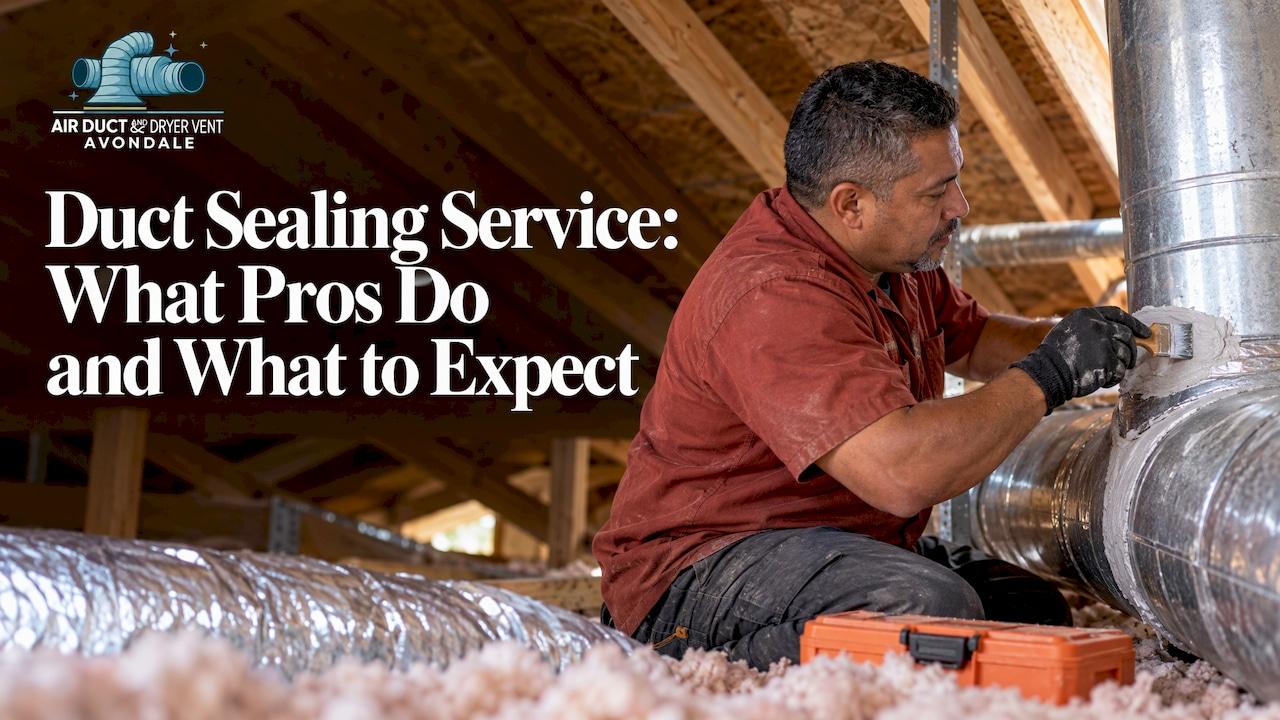
A professional duct sealing service finds the leaks in your ductwork, measures them, closes them with approved materials and checks that the system still works safely afterward. It is a performance job on the whole duct system, not a coat of sealant on the seams you can see. If your Avondale home or building has ducts in a hot attic, uneven rooms or high cooling bills, this is the work that fixes the cause. Our team handles ductwork repairs and duct replacement for homes and commercial properties in Avondale, so the first step is a look at what your ducts are actually doing.
TL;DR
- A typical house loses about 20% to 30% of the air moving through its ducts to leaks, holes and poor connections.
- Real sealing means testing leakage, repairing damaged runs, sealing with mastic, UL-listed tape or aerosol sealant, insulating ducts in unconditioned space and checking airflow afterward.
- Sealing is not duct cleaning. Sealing stops air leakage; cleaning removes dust and debris from the system.
- One university estimate puts sealing at about $0.40 per square foot of floor space, with simple paybacks of seven to fourteen years.
- If you have gas or oil appliances, combustion safety must be tested after sealing.
Table of Contents
- What a duct sealing service actually is
- Signs your ducts are leaking
- What a professional job includes
- Why a visible patch is not enough
- The safety step you should never skip
- What duct sealing costs and what you get back
- How to judge a duct sealing proposal
- When sealing is not the right fix
- How often to inspect and reseal
- Perspective
- Get your ducts looked at in Avondale
- FAQ
- Sources
What a duct sealing service actually is
Your air conditioner or furnace only does half the job. The ducts carry the conditioned air to each room, and every gap, split seam or loose joint lets some of it escape into the attic, crawlspace or wall cavity. You pay to cool that air, and it never reaches the room.
Duct sealing closes those gaps. It is often confused with two other jobs, so it helps to separate them:
| Job | What it does | What it does not do |
|---|---|---|
| Duct sealing | Closes leaks at seams, joints, plenums and register boots | Does not remove dust or debris |
| Duct cleaning | Removes dust and debris from ducts and system components | Does not fix leaks |
| Duct repair or replacement | Fixes crushed, disconnected or damaged runs, or replaces them | Is not needed where ducts are sound and only leaking at joints |
The EPA draws the same line. It says sealing duct air leaks can save heating and cooling energy, while applying sealants to the inside surfaces of ducts to trap contaminants is not generally recommended. Those are two different things, even though both involve a product going into the ducts.
In practice the three jobs often go together. A damaged section gets repaired or replaced, the joints get sealed, and if the system is dusty it gets cleaned. A good contractor tells you which of these your system needs and which it does not.
Signs your ducts are leaking
You rarely see duct leaks. You see what they cause. ENERGY STAR lists these symptoms:
- High utility bills.
- Rooms that are hard to heat or cool.
- Stuffy rooms.
- Ducts running through attics, crawlspaces or garages.
- Tangled or kinked flexible duct.
The University of Illinois EnergySense program adds visible clues: dust or black marks at leakage points and heated or cooled air escaping at joints.
In Arizona, most homes have ducts in the attic, which is the harshest place for them. Leaks there pull hot attic air into the system and push cooled air out into the heat. That is why uneven rooms and bills that climb through the summer are worth investigating. Our guide to what air duct leaks are and how they get fixed walks through the common failure points.
For a business, the same signs show up as hot or cold offices, complaints from tenants and HVAC equipment that runs long hours without hitting the setpoint. Property managers often see it first as a pattern: the same suites generate the same calls.
What a professional job includes
The best public checklist comes from ENERGY STAR. It says a professional duct improvement should include:
- An inspection of the whole duct system.
- An evaluation of air balance between supply and return.
- Repair of damaged or disconnected ducts.
- Straightening of tangled or crushed flexible duct.
- Sealing of leaks and registers.
- Insulation of ducts in unconditioned areas to R-6 or higher (R-value measures resistance to heat flow, so higher is better).
- A new filter.
- An airflow evaluation.
- Combustion safety testing where it applies.
Notice how much of that is not sealant. Crushed flex duct, a disconnected trunk line or a missing return path will undo the benefit of perfectly sealed seams. This is why the same ENERGY STAR page treats sealing as a system project rather than a patch.
Testing comes first
The U.S. Department of Energy's Home Improvement Expert checklist, written with Pacific Northwest National Laboratory, says duct leakage should be tested before sealing, using a method from RESNET Chapter 8 or ACCA Standard 5. It sets a target of 10% of total airflow or less, and says airflow should be measured at each register with a powered flow hood, a device that captures the air coming out of a vent and reads the volume.
A before and after measurement is the difference between a job you can trust and a job you have to take on faith. It tells you how much leakage there was and how much is left.
The three sealing methods
There are three common ways to close leaks. A 2024 guide from the National Air Duct Cleaners Association describes each:
- Mastic: a thick, flexible compound brushed over seams and joints. It stays pliable as ducts expand and contract.
- UL-listed metallic tape: a localized fix for specific joints and seams. The DOE checklist specifies UL 181 tape, a standard for duct tape that holds up in real heating and cooling conditions. Ordinary cloth duct tape fails fast.
- Aerosol sealing: sealant particles are injected into the pressurized duct system and settle on the edges of leaks from the inside, which makes it useful when ducts are buried in walls or insulation and cannot be reached.
The DOE checklist accepts UL-approved mastic, UL 181 tape or an equivalent aerosol sealant for leaks, connections and plenums. Which one fits depends on access. Open attic trunk lines suit mastic. Hidden runs may call for aerosol.
Why a visible patch is not enough
Some homeowners seal what they can see with tape from a hardware store. Energy Trust of Oregon explains why that falls short: a professional job includes whole-system leakage testing, access to concealed ducts, correct UL 181 materials and insulation, and combustion safety testing when gas or oil appliances are present.
In short, the leaks you can see are a fraction of the leaks you have. The big ones are often at the plenum (the box where the air handler connects to the main trunk), inside wall cavities and at the boots behind the registers. They need tools, access and a test to find and verify. For a lighter look at small gaps versus hidden ones, see our piece on duct leak repair methods.
The safety step you should never skip
If your home has a gas furnace, a gas water heater or any other fuel-burning appliance, ask about combustion safety. Energy Trust warns that pressure changes from improperly sealing a home or duct system can cause backdrafting, where exhaust gases, including carbon monoxide, are pulled back into the living space instead of leaving through the flue. Qualified professionals should test combustion safety after sealing.

This applies to residential and commercial buildings alike. If you manage a property with gas heating or water heating, make combustion testing part of the written scope. Working carbon monoxide alarms are a sensible safeguard in any building with fuel-burning equipment.
What duct sealing costs and what you get back
Prices vary with the size of the building, how accessible the ducts are and how much repair is needed beyond sealing. Two published benchmarks give you a frame:
- The University of Illinois EnergySense page reports about $0.40 per square foot of floor space, with simple paybacks of seven to fourteen years. It also notes comfort, air quality and equipment life benefits.
- A report from the Energy Technologies Collaborative on small commercial buildings lists manual mastic and tape sealing at $0.50 to $1.50 per square foot of building, with about 40% to 50% leakage reduction. It lists aerosol sealing at about $1 per square foot, with roughly 70% to 90% leakage reduction. These figures come from California prototypes and California energy prices, so treat them as a range for comparison, not a quote for Arizona.
On savings, the DOE and PNNL checklist says properly sealed and insulated ducts can cut utility bills by up to 20%, especially where ducts run through unconditioned attics, basements or crawlspaces. Results depend on how leaky the system was to begin with.
A worked example: for a 2,000 square foot home, the Illinois figure of $0.40 per square foot works out to roughly $800 for the sealing portion. Repairs to crushed or disconnected ducts, new insulation or filter changes would be additional. That is an illustration of the arithmetic, not a quote. Our own pricing is set after we see the system, and our breakdown of what homeowners pay for duct sealing explains the cost drivers in more detail.
Also ask your electric utility whether it offers an incentive for duct testing or sealing. The DOE checklist recommends checking utility, state, local and federal programs before you commit, and offers change, so confirm the details with the program itself.
How to judge a duct sealing proposal
Whether you are a homeowner or a property manager, the same questions separate a real job from a cosmetic one. The DOE and PNNL checklist advises choosing licensed, insured and certified contractors, checking references and reviews, and getting multiple written bids. Add these questions to that list:
- Will you measure leakage before and after? You want numbers, not a promise.
- What are you sealing with? The answer should be mastic, UL 181 tape or aerosol sealant, not cloth duct tape.
- Will you check airflow at the registers? Sealing without checking balance can leave rooms no better off.
- What happens to ducts in the attic? Insulation to R-6 or higher is the ENERGY STAR benchmark for unconditioned spaces. Our article on why duct insulation matters covers what to look for.
- Will you test combustion safety if I have gas appliances?
- What is in writing? Scope, materials, test results and any warranty.
A proposal that cannot answer these is a proposal for a patch.
When sealing is not the right fix
Sealing works on ducts that are structurally sound. If the ductwork is crushed, collapsed, water-damaged or badly deteriorated, new tape or mastic is only a temporary cover. In that case, the better path is repair or replacement. We explain how to tell the difference in our guides on repairing ductwork and ductwork replacement. Our air duct replacement service is there for the runs that are past saving.
A good inspection settles this before anyone opens a tube of sealant.
How often to inspect and reseal
There is no official resealing schedule in the sources we used, so treat any single number with care. What is clear is where problems start: tape that dries and lifts, mastic that cracks, ducts that sag or get disturbed by other trades working in the attic. A sensible routine is to have the ducts looked at when your HVAC system is serviced, and again after any remodel, roof work or equipment replacement that put people in the attic.
Between visits, watch for the symptoms listed earlier: rising bills, rooms that stop keeping up, new dust at joints. Our routine duct inspection workflow lays out what a homeowner can observe from the outside, and a new filter on schedule keeps the system from working harder than it has to.
Perspective
We see duct sealing as one part of a bigger question: is your air getting where you paid for it to go? A bill that keeps climbing is rarely about the thermostat. It is usually about air escaping before it reaches a room.
That is why we do not treat ducts as an add-on. Our work is built around air ducts, vents and HVAC systems, with commercial-grade equipment and trained technicians, and we back our services with warranties. Cleaning, repair, replacement and filter changes belong in one conversation because they affect each other. A leaky duct that is also dirty and uninsulated needs a plan, not a single product.
For commercial clients, we offer flexible scheduling, including after-hours options, so the work does not interrupt your tenants or customers.
If you want to understand what your ducts are doing, start with an inspection and a straight answer about what the system needs.
Shaun
Get your ducts looked at in Avondale
We serve homeowners, small businesses and property managers across Avondale, AZ. Our services cover ductwork repairs, duct installation, air filter replacement and air quality testing, plus A/C repair when the equipment is part of the problem. For offices, retail and multi-unit buildings, see our commercial air duct cleaning page. We also offer bundled discounts when several services are done together.
Tell us what you are noticing, whether it is hot rooms, high bills or dust at the vents, and we will help you work out the right next step. You can reach us through our main site.
FAQ
Is duct sealing a good idea?
For most homes with ducts in unconditioned space, yes. ENERGY STAR says a typical house loses about 20% to 30% of duct air to leaks, and DOE and PNNL say sealed and insulated ducts can cut utility bills by up to 20%. The benefit depends on how leaky the system is, which is why testing first matters.
Is duct sealing the same as duct cleaning?
No. Sealing closes air leaks in the duct system. Cleaning removes dust and debris from ducts and components. The EPA also says routine duct cleaning has not been shown to prevent health problems, so the two should be chosen for their own reasons. If your ducts are dusty and leaking, they may need both.
How long does a duct sealing job take?
The sources we used do not give a standard duration, and it depends on the size of the system, access to the ducts and how much repair comes with it. Ask for the expected time on site in your written proposal, along with the scope and materials.
Can I seal my own ducts with tape?
Tape on visible seams is not the same as a tested seal. Energy Trust notes that professional work includes whole-system leakage testing, access to concealed ducts, UL 181 materials and combustion safety checks when gas or oil appliances are present. Those last checks matter for your safety, so have a qualified professional do them.
Does duct sealing affect gas appliances?
It can. Improperly sealing a duct system can change pressure in the home and cause combustion appliances to backdraft. Have combustion safety tested after sealing if you have a gas furnace, water heater or other fuel-burning appliance.
Sources
- Duct Sealing | ENERGY STAR
- Hire a Professional Contractor for Duct Improvement | ENERGY STAR
- Should You Have the Air Ducts in Your Home Cleaned? | US EPA
- HVAC Ductwork | University of Illinois EnergySense
- DOE Home Improvement Expert Fact Sheet and Checklist: Duct Sealing | PNNL
- A Beginner's Guide to Duct Sealing | NADCA
- When to call in a pro for duct sealing | Energy Trust of Oregon
- Commercial Building Duct Sealing Energy Savings and Cost Analysis | ETCC