
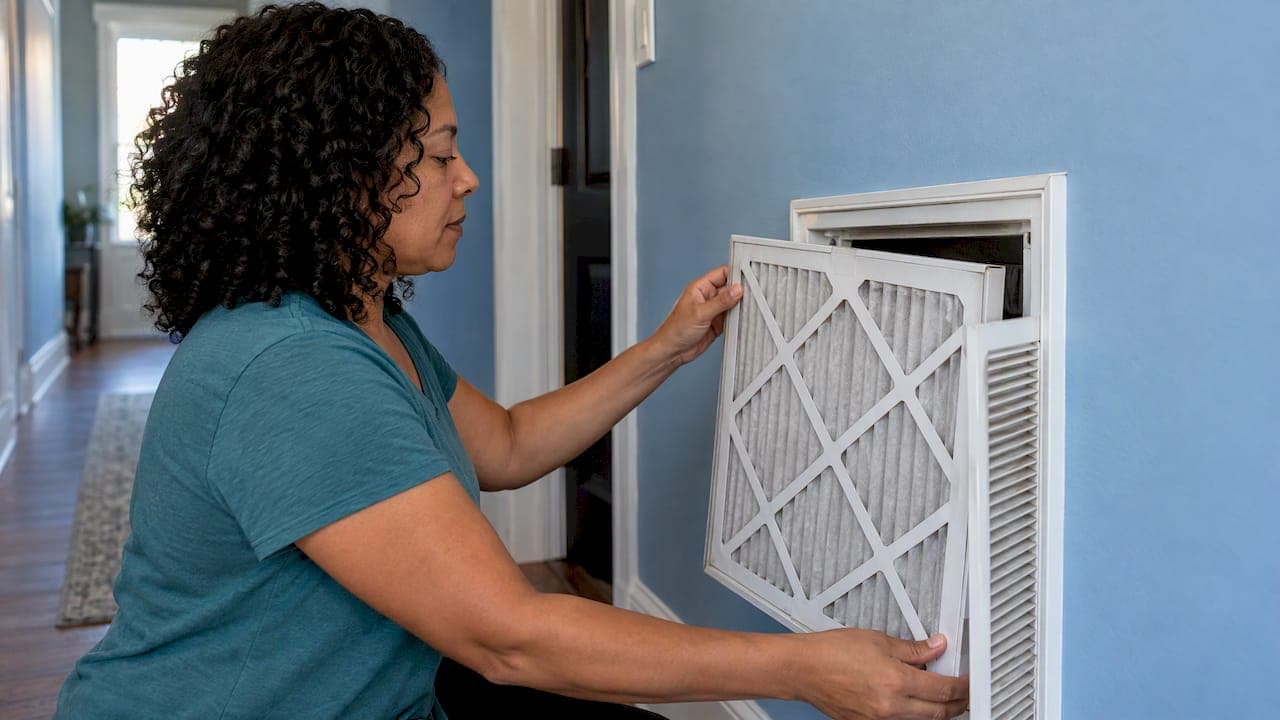
In almost every home with central heating and cooling, a furnace filter and an AC filter are the same filter. One filter sits in the return side of a single duct system, and the same air moves through it whether the furnace or the air conditioner is running. Trane's homeowner guidance notes that people call that one part either name. The differences that matter are size, MERV rating, thickness and how often you change it, not the label on the box.
This guide explains why the names get mixed up, the few cases where two filters really are different, how to read the numbers on the frame, and how to keep a filter working in a dusty Valley climate like Avondale's.
TL;DR
- Furnace filter, AC filter and HVAC filter usually mean the same product: one filter on the return side serves both heating and cooling.
- Buy by size, thickness and MERV rating. Match the MERV to what your system was designed for, not to the highest number on the shelf.
- Check the filter monthly and replace it when it is dirty. Standard 1-inch filters should not go past 90 days.
- Never run the system without a filter. Dirt reaches the coil and blower, and repairs cost far more than a filter.
- In Avondale's dusty, long cooling season, expect to change filters more often than the package says.
Table of Contents
- Why people think they are two different filters
- Where the filter actually lives
- When two filters really are different
- How to buy the right one: size, thickness, MERV
- What happens without a filter, or with a clogged one
- How often to check and change it
- Can you change it yourself?
- Our perspective
- When the filter is not enough
- FAQ
- Sources
Why people think they are two different filters
The confusion is mostly about language. Furnaces were the first appliance to carry a filter, so hardware stores label the product "furnace filter." Once central air arrived, the same duct system and the same filter served cooling too. Now you will see "AC filter," "HVAC filter," "air handler filter" and "furnace filter" on products that are physically identical.
An industry overview from American Home Shield makes the same point: the same filter works for heating and cooling, so the names are used interchangeably. You do not swap filters when the season changes. You do not need a summer one and a winter one.
A second source of confusion is the plain "air filter." That term also covers filters for room air purifiers, window units and portable devices, which are built differently and do not fit a duct system. If a product says "air purifier filter," it is not what your furnace takes.
Where the filter actually lives
The filter is on the return side of the system, the side that pulls room air back toward the equipment. The U.S. Department of Energy's Building Science Education resource explains that filters are installed on the return side of ducted heating and cooling systems, where they protect the blower motor and improve indoor air quality.
In a traditional split system, Trane says the filter is commonly found at the furnace or indoor air handler, or behind a large return-air grille. In practice you will find it in one of these places:
- In a slot on the side or bottom of the air handler or furnace, often in a closet or garage.
- Behind a large return grille in a hallway, ceiling or wall, held by a latch or small tabs.
- In more than one grille, in larger homes with several returns. Each one needs its own filter.
If you are not sure which applies to you, our guide to finding your main air filter locations walks through the usual spots. Building America researchers at Pacific Northwest National Laboratory add one useful point: for best results, place the filter where the homeowner can reach it easily, because an easy filter gets changed more often.
Filter at the unit or at the return grille?
Both work. A filter at the unit is out of sight and tends to be a standard slot size. A filter at the grille is easy to check every time you walk past, and it keeps dust out of the duct before it travels. What matters is that all the air passes through a filter and none leaks around it. A gap at the edge lets dust bypass the media and coat the coil and blower.
When two filters really are different
A few setups break the "one filter" rule:
- Separate heating and cooling equipment. Some homes have a furnace on one duct system and a different cooling system on another, or a ductless mini-split. Nordic Pure notes that separate systems may require specific filter types because of their own design or size.
- Multiple returns. Different grilles can take different sizes. Measure each one.
- Media cabinets and thick filters. Some systems use a deep 4 or 5 inch filter in a dedicated cabinet instead of the 1-inch kind. Trane, for example, makes a high-efficiency cabinet filter that should be changed every 6 months, sooner if it is dirty or clogged.
- Mini-splits and window units. These have small washable screens inside the indoor head. They are not the same product at all.
If your home is a typical Avondale single-family house with one furnace or air handler and one set of ducts, you almost certainly have one filter size and one type to buy.
How to buy the right one: size, thickness, MERV
Size: nominal versus actual
The large number printed on a filter frame is the nominal size, such as 16x25x1. The real measurement is usually a little smaller. Manufacturers explain that nominal size is a rounded figure while actual size is the precise measurement. Buy by the nominal size printed on the old filter, and measure only if the old one is missing or unmarked.
Airflow direction
Every filter frame has arrows. They should point toward the HVAC unit and away from the return duct. Trane also warns that a filter installed backward makes the system work harder and use more energy.
MERV rating
MERV is the Minimum Efficiency Reporting Value. The EPA's Indoor airPLUS bulletin explains that higher MERV ratings capture smaller particles but can raise resistance to airflow. The same document says that when you choose a high-MERV filter, you need to check that the ductwork and fan can handle the pressure drop.
Building America guidance is practical: choose MERV 6 or higher that matches the system's design, and do not go above the rating the system was designed for. Here is how that plays out for most homeowners:
| Filter type | What it does | Best for |
|---|---|---|
| Basic MERV 1 to 4 | Catches large debris, protects the equipment | Little more than equipment protection |
| MERV 6 to 8 | Better dust and lint capture with low resistance | Many standard residential systems |
| MERV 11 to 13 | Captures finer particles, higher airflow resistance | Systems designed for it, households with allergies |
For a deeper look at the numbers, see our explainer on MERV 8 to 13 ratings and when to upgrade. If you are weighing the options, HVAC filter examples for cleaner air shows how the common types compare.
Do not stack filters
Two filters in one location sounds like double protection. It is not. Filter makers advise that using more than one filter in the same spot can restrict airflow too much. One correctly sized filter of the right rating is the goal.
Disposable or washable
Air filters fall into disposable and reusable groups. Washable aluminum filters need frequent cleaning and careful drying before reuse. A damp filter put back in a warm system is a poor trade. Most homeowners are better off with a pleated disposable one.

What happens without a filter, or with a clogged one
The filter is cheap, and everything behind it is not. The EPA bulletin states that a dirty or clogged filter can dramatically reduce airflow, which means longer furnace run time, more motor wear and higher energy use.
ENERGY STAR's guidance, last updated February 2, 2024, says a dirty filter makes a central air conditioner, furnace or heat pump work harder, which can raise energy costs and damage equipment.
No filter at all is worse. This Old House reports that in a combined furnace and AC system, running without a filter can let dirt clog the cooling coil, which may freeze and break. A frozen coil in an Arizona July is the kind of problem that turns a $10 filter into a repair call.
Signs your filter is overdue:
- Weak airflow from supply vents
- Dust building up on furniture faster than usual
- The system running longer to reach the set temperature
- A visible gray mat of lint on the filter surface
How often to check and change it
ENERGY STAR recommends checking the filter monthly and cleaning or replacing it when dirty. Trane says standard 1-inch filters should be changed at least every 90 days. Treat 90 days as the ceiling, not the target.
In the Phoenix area, several things push you toward the shorter end:
- Long cooling season. The blower runs for much of the year, so the filter loads up faster than in a mild climate.
- Fine desert dust. Windy days and nearby construction put more dust in the air.
- Pets and allergy sufferers. Hair and dander clog pleated media sooner.
- Newly built or remodeled homes. Drywall and construction dust can overwhelm a new filter in weeks.
A simple routine: look at the filter on the first of every month, hold it up to a light, and replace it if you cannot see light through the media. Our HVAC filter change sequence guide helps you build a schedule you will keep.
One more detail: Nordic Pure points out that dust can settle on an idle filter and hurt efficiency when the system restarts. If a vacation home or a rarely used unit has been sitting, change the filter before the first run of the season.
Can you change it yourself?
Yes, and you should. Replacing a filter is a homeowner task. ENERGY STAR's steps are short: turn off the furnace, air conditioner and fan; open the cover or grille; remove the old filter; and slide in the new one with the arrow pointing toward the furnace or blower.
A few things make it easier:
- Write the size and the date on the filter frame with a marker.
- Take a photo of the old filter's size label before you go shopping.
- Buy a few at once so the next change is not postponed.
- Vacuum around the slot or grille opening while it is open.
If the filter slot is damaged, the grille does not seal, or you cannot find a filter anywhere in the system, that is the point to call a professional.
Our perspective
We clean ducts, vents and dryer vents across Avondale, and we open a lot of systems. The pattern is consistent: the homes with the dirtiest ducts are rarely the ones with the wrong filter. They are the ones where the filter was forgotten, put in backward, stacked two deep, or swapped for the highest MERV available without checking whether the system could breathe through it.

Our advice is plain. Know your size, pick a rating your system was designed for, and put a monthly reminder in your phone. A good filter does not replace duct cleaning, though. A filter stops what comes to it. It cannot remove dust that built up before it was installed, or dust that gets past a loose fit. If you see debris at the vents, a musty smell, or leftover construction dust, the ductwork itself needs attention.
We also see how a neglected filter shows up elsewhere. Restricted airflow means the blower strains, the coil gets dirty and the system is harder to keep comfortable. If you want to understand more of this chain, we wrote about how HVAC system wear affects air quality and efficiency and how air filters protect your home's health.
— Shaun
When the filter is not enough
A filter is the first line of defense. If you have changed it on schedule and still see dust blowing out of the vents, uneven cooling, or a stale smell when the system starts, the problem is probably downstream. That is where we come in.
We handle air duct cleaning for homes and businesses in Avondale, along with air vent cleaning, duct repair and replacement, filter replacement and indoor air quality testing. We also clean dryer vents, which have nothing to do with your furnace filter but share the same lint and airflow problem. Our services come with warranties, and we offer flexible scheduling, including after-hours options for commercial clients.
To discuss your system, visit the services page or contact us for a booking.
If you manage a property, the same filter logic applies at larger scale: more returns, more filters, more chances to miss one. Our commercial air duct cleaning service fits around business hours.
FAQ
Are furnace and AC filters the same?
In a typical central system, yes. The same filter on the return side serves heating and cooling, and the names are used interchangeably. The exception is a home with separate systems, or a ductless unit with its own screens, where each may need a specific type and size.
Can I use a furnace filter in my AC?
If the size and thickness match the slot or grille, yes. In a split system the AC blows air through the same ducts and filter as the furnace. Check the MERV rating against what your system was designed for, since a rating that is too high can restrict airflow.
What happens if I do not put a filter in my furnace?
Dust and debris go straight to the blower and coil. The EPA notes that restricted or missing filtration raises motor wear and energy use, and This Old House reports that dirt can clog a cooling coil until it freezes. Put a filter in before running the system, even briefly.
Will a filter affect my AC?
Yes. A clean filter of the right rating lets air flow freely. A clogged one or one with too high a MERV makes the system work harder and can raise energy costs. If cooling feels weak, check the filter first.
Can I change my AC filter myself?
Yes. Turn the system off, open the filter cover or grille, pull the old filter, and insert the new one with the arrow pointing toward the furnace or blower. It takes a couple of minutes, and ENERGY STAR recommends checking it monthly.
Sources
- Trane: HVAC System Filters
- Trane: Air Filter Cleaning and Maintenance Guide
- American Home Shield: Guide to Replacing HVAC Filters
- U.S. Department of Energy: HVAC Proper Installation of Filters
- PNNL Building America: Proper Installation of Furnace and Air-Handler Filters
- EPA Indoor airPLUS Technical Bulletin: Filtration
- ENERGY STAR: How to Keep Your HVAC System Working Efficiently
- MANN+HUMMEL: FAQs and Industry Terms
- Nordic Pure: AC Filters vs. Furnace Filters
- Nordic Pure: Help Center FAQs
- This Old House: Why Is Furnace Maintenance Important?