
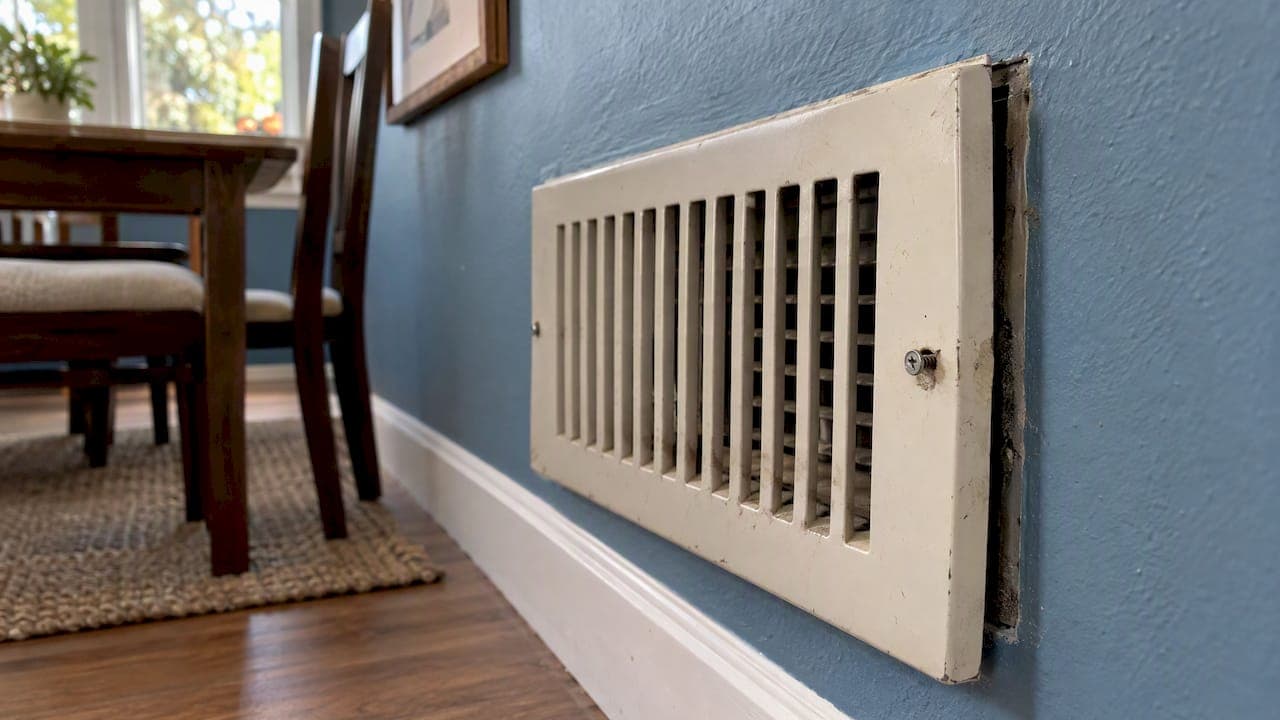
A loose vent cover almost always comes down to one of three things: screws that no longer bite, a cover that has bent out of shape, or a duct opening that no longer gives the cover a solid seat. Take the cover off, look at the screws, the holes and the rim of the opening, and you will know which one you have in about five minutes. Most fixes cost a few dollars and take less than half an hour.
This guide walks through the diagnosis, the repair for each cause, how to measure for a replacement, and the point where a rattling or sagging register is telling you something about the duct behind it.
TL;DR
- Remove the cover first. Screws that spin freely mean stripped holes, bowed edges mean a warped cover, and a damaged duct rim means poor support.
- Fix stripped drywall holes with toothpicks for minor damage or a plastic anchor for worse damage. Never glue a floor cover down permanently.
- Replace the cover if it is cracked, warped, heat-deformed or will not sit flat. Measure the duct opening, not the old cover.
- A gap around the duct boot leaks conditioned air. Seal it with sealant or mastic, not ordinary duct tape.
- If airflow or comfort problems continue after the cover is secure, the problem is likely in the ductwork, not the cover.
Table of Contents
- Why vent covers come loose
- What you need before you start
- Fix 1: Missing or short screws
- Fix 2: Stripped screw holes
- Fix 3: A bent or warped cover
- Fix 4: Floor vents that shift or rattle
- When the gap is around the boot, not the cover
- Repair or replace? A decision guide
- After the fix: a quick test
- When a loose cover is a symptom
- Our perspective
- Need a hand with loose, damaged or mismatched vents?
- FAQ
- Sources
Why vent covers come loose
A vent cover, also called a register or grille, has a simple job: sit flat over the duct opening and let air through. Supply registers are the louvered covers where heated or cooled air enters a room. According to the Building America Solution Center, ceiling registers in a one-story home most likely connect to ducts in the attic, while floor registers most likely connect to ducts in a basement or crawlspace. That matters, because the cover is only as secure as whatever it is fastened to.
In our experience, the usual causes are:
- Missing, short or stripped screws. Vibration from the blower, repeated filter changes and cleaning, or a cover that was reinstalled a few times can wear out a hole in drywall.
- A bent or warped cover. Thin stamped metal and cheap plastic distort, and a distorted cover cannot seat flat, so it rocks or lifts at one corner.
- A damaged duct rim or boot. The boot is the sheet-metal or plastic piece that connects the duct to the ceiling, wall or floor. If its edge is bent or a tab has broken off, the screw has nothing to grip.
- A cover that is the wrong size. A cover that is only slightly undersized can shift every time the system cycles.
- Uneven surfaces. A wall or floor that is not quite flat will let a rigid cover rock.
The five-minute diagnosis
Turn the system off, then remove the cover. Look at three things:
- The screws. If they spin freely without tightening, the holes are stripped. If they are missing or visibly too short to reach solid material, you only need the right screws.
- The cover itself. Lay it face down on a flat table. If the edges are bowed or it rocks, it is deformed.
- The opening. Shine a flashlight around the rim. Look for bent edges, a missing tab where a screw should land, or screws protruding from the boot.
Each failure needs a different repair, so it is worth doing this before you buy anything.
What you need before you start
Most jobs need only a screwdriver or drill with a small bit, a flashlight and a vacuum. For ceiling work, wear eye protection, since the Building America Solution Center recommends it when you work overhead, and vacuum loose debris from around the opening once the cover is off. Depending on the cause, add:
- Longer screws of the same head style
- Toothpicks or wooden matchsticks
- Plastic wall anchors, or toggle bolts for larger holes
- Small self-adhesive rubber pads for floor vents
- A replacement cover, if yours is damaged
Keep the old cover and one old screw in your pocket if you go to the hardware store. Matching screw thread and head type is easier in person.
Fix 1: Missing or short screws
This is the easiest case. The Michelle Hirsch Group advises checking first for missing, short or stripped screws, and notes that swapping in a slightly longer screw may restore the hold. Choose a screw that is just long enough to reach solid material, not so long that it pushes through into the duct and blocks the damper or snags the airflow. Snug it down, but stop when it is firm. Overtightening is how many holes get stripped in the first place.
Fix 2: Stripped screw holes
If the screw spins and does not bite, the hole has lost its grip. You have three reliable options, from least to most work.
Toothpicks for a minor strip
Dip one or two toothpicks in a little wood glue, push them into the hole, snap them off flush and let them set. Then drive the screw back in. The wood packs the hole and gives the threads something to bite. The Michelle Hirsch Group describes this same toothpick method for a stripped hole.
A plastic anchor for damaged drywall
When the drywall around the hole has crumbled, enlarge the hole slightly to the anchor's size, tap in a plastic wall anchor and drive the screw into it. For larger or badly damaged holes, a toggle bolt spreads the load behind the drywall. Only use these where the cover mounts into drywall and there is open space behind it. If you are unsure what is behind the wall, do not drill deeper than the anchor requires.
Move the screw or attach to the duct
If the drywall is too far gone, move the screw positions to solid material, or fasten the cover directly to the duct or boot where the design allows. An iFixit repair guide makes the same point: a worn screw hole can be bypassed by attaching the vent cover to the ductwork rather than relying on damaged drywall. A friction-fit cover, or a magnetic cover on a metal boot or frame, is another way to avoid drilling into weak material.
Fix 3: A bent or warped cover
A slightly bent metal cover can be straightened. Remove it, lay it on a flat surface, and press the bowed edge back gently with your hands or by tapping a block of wood. Do not hammer it directly. Then hold it against the opening to see whether it sits flat.
If it springs back, has creases, or the finish cracks as you work it, stop and replace it. A cover that has been bent several times will not hold a flat seat for long.
Fix 4: Floor vents that shift or rattle
Floor registers get stepped on, bumped by furniture and vacuumed around, so they move more than ceiling covers. Check that the underside lip of the register sits inside the duct opening rather than perched on the edge. If the cover is the right size and still shifts, small rubber pads under the corners cut movement and noise. The Michelle Hirsch Group recommends them and advises against permanent glue, which makes later cleaning and replacement miserable and can damage the finish.
A thin strip of foam weatherstripping or felt along the underside of the frame can also quiet metal-on-metal buzzing. Keep it clear of the louvers and the damper, so it does not block airflow.
If the rattle persists even when the cover is snug, the noise may be coming from air moving through the duct, not the cover. Our guide to HVAC noise reduction explains how to tell the difference.

When the gap is around the boot, not the cover
Sometimes the cover is fine and the problem is behind it. If the duct boot has pulled away from the ceiling drywall or flooring, you will see a gap when the cover is off, and the cover may sag because it has nothing solid to land on.

That gap is more than a nuisance. The Building America Solution Center says loose or unsealed gaps where a register boot meets ceiling drywall or flooring can leak conditioned air into attics, crawlspaces, basements or spaces between floors, and can admit dust, humidity and soil gases. A PNNL code-compliance brief adds that poorly sealed register boots can cause air leakage, condensation and water damage around the boot's connection to the floor, ceiling or wall covering.
How to seal it
The guidance depends on the size of the gap:
| Gap size | Recommended approach | Source |
|---|---|---|
| Up to 1/4 inch | Caulk or sealant | Building America Solution Center |
| Under 3/8 inch | A bead of sealant or mastic | Building America sealing guide |
| Larger than 3/8 inch | Fiberglass mesh tape plus mastic | Building America sealing guide |
The two official pages draw the line slightly differently (1/4 inch versus 3/8 inch for sealant alone). If your gap is between the two, use the more cautious approach: mesh and mastic. For large gaps, the Solution Center also notes that mechanical attachment may be needed along with UL 181 tape or fiberglass mesh. The Department of Energy's mastic job aid says supply boots should be mechanically fastened to the subfloor and that gaps between the subfloor or ceiling and the boot should be sealed.
Skip the duct tape
Ordinary cloth "duck" tape is not a duct sealer. Building America Information Sheet 602 says temperature cycling can dry out its adhesive. UL 181A or 181B tape can work on clean, dry surfaces. The same sheet notes that register-to-boot and register-to-drywall connections are among the connections that commonly leak.
Repair or replace? A decision guide
Repair when the cover is sound and the problem is the fastening. Replace when the cover itself is the problem. As a rule of thumb we use on service calls:
| What you find | Do this |
|---|---|
| Missing or short screws | Repair: new screws |
| Stripped holes in drywall | Repair: toothpicks, anchor or toggle |
| Slightly bent metal cover that straightens flat | Repair, then test the fit |
| Cracked, warped or heat-deformed cover | Replace |
| Plastic cover that has softened or lost its shape | Replace |
| Cover that keeps falling after proper repair | Replace the cover, then check the boot |
| Bent or broken boot, or visible gap you cannot seal | Call a pro |
If a cover has fallen more than once or twice after you have fixed the screws, stop repeating the same repair. Either the cover or what it mounts to is not doing its job.
Measuring for a replacement
Measure the duct opening, not the old cover. Covers are sold by the size of the opening they fit, so a grille listed as 10 by 4 inches is meant for a 4-by-10-inch opening, and the outside dimensions of the decorative frame will be larger. Measure the opening width, then the height, in inches, and note whether the cover mounts to a wall, ceiling or floor. Also check:
- Mount type: screw holes, or a no-hole friction fit
- Damper: whether you need one to adjust airflow
- Duty: floor covers need to bear weight; ceiling and wall covers do not
- Material: metal for durability, with a finish that matches your trim
If you cannot find a stock size that fits an odd opening, our air vent replacement service can handle that for you.
After the fix: a quick test
Run the system for a few minutes and check:
- The cover sits flat with no visible gap around the edge.
- It does not move, buzz or rattle when the air comes on.
- Air still flows freely and nothing, such as foam strip or a drooping screw, is restricting the louvers.
- Hold a hand a few inches from the edge for any air blowing sideways. That points to a leak around the boot.
If the ducts behind a register are not accessible, homeowners can still seal around boots from inside the room, according to the Building America Solution Center. But it also says persistent poor airflow or room comfort problems justify bringing in a contractor, possibly for duct-blaster testing, because the visible register may not be where the leak actually is.
When a loose cover is a symptom
A cover can be loose for a boring reason. But if you see several of these together, look past the register:
- Dust streaks or dark staining around the edge of the cover
- A room that is always warmer or cooler than the rest
- Rattling that comes and goes with the system
- Condensation or water marks near the register
- A boot that has visibly dropped or separated from the ceiling
The Building America best practices report from PNNL and Oak Ridge National Laboratory says registers and grilles should be sealed to the ducts and that damaged or disconnected ductwork should be repaired, because unsealed ducts can pull dust, moisture and contamination from unconditioned spaces. If that sounds like your house, these guides will help you sort out what you are seeing:
- Reasons for HVAC airflow loss
- Quick checks for uneven airflow
- What air duct leaks are and how to fix them
For a wider walk-through of register problems, see our practical guide to air vent issues.
Our perspective
We clean and repair ducts for a living, and loose covers are one of the most common things we see on service calls in Avondale. The cover is almost never the real story. A cover that has fallen is usually the visible end of something else: a boot that was never fastened properly at installation, a gap nobody sealed, or years of removing and refitting the same two screws into soft drywall.
Our advice is to fix the fastening first, because it is cheap and you will learn what is behind the wall. Replace the cover only when it is damaged, since a new cover screwed into a stripped hole falls off just as fast. And do not tape over a gap and call it done. A register is the one part of your duct system you can see, so treat what it shows you as a clue about the parts you cannot.
We also would rather you did a simple job yourself than paid for one you did not need. If the repair turns out to involve the boot, the duct or a leak, that is where an experienced technician earns the call.
— Shaun
Need a hand with loose, damaged or mismatched vents?
If the cover is cracked, the opening is an odd size, or you open one up and find a damaged boot, we can help. Our air vent replacement service covers replacing vents in Avondale homes and businesses, and for broken or leaking ducts behind them we also handle air duct replacement and ductwork repairs. We offer warranties on our services and flexible scheduling, including after-hours options for commercial clients. Pricing is not published online, so contact us for a quote.
If the vents are dirty as well as loose, air vent cleaning is a sensible add-on while the covers are off. Reach us through our main site.
FAQ
How do I get a vent cover to stay on?
Remove it and check the screws and holes. Replace missing or short screws, and pack a stripped hole with toothpicks or use a plastic anchor in damaged drywall. If the cover is bent, straighten it gently on a flat surface or replace it.
Why does my air vent cover keep falling off?
Usually the screw holes are stripped or the cover no longer sits flat. Less often, the duct boot behind it is bent, has pulled away from the ceiling or wall, or has a broken tab. Each cause needs a different repair, so diagnose before you buy parts.
How do I fix a loose ceiling air vent?
Wear eye protection, remove the cover, and vacuum around the opening. Replace short screws, then repair stripped holes with toothpicks, an anchor or a toggle bolt. If there is a gap between the boot and the drywall, seal it with sealant or mastic rather than tape. If the boot itself has dropped, call a technician.
Can I use tape or glue to hold a vent cover on?
We would not. Ordinary cloth tape is not suitable for sealing ducts because its adhesive can dry out with temperature cycling, and permanent glue makes cleaning and replacement difficult. Use proper fasteners, rubber pads for floor vents, or a cover designed to friction-fit or attach magnetically.
When should I call a professional?
Call when the boot is bent, broken or pulled away, when you cannot seal the gap yourself, or when comfort and airflow problems continue after the cover is secure. The register may not be where the problem actually sits, and duct testing can find it.
Sources
- Air Seal and Repair Ducts, Building America Solution Center
- Air Seal Duct Boots to Floors or Ceiling Drywall, Building America Solution Center
- Sealing Heating, Ventilating, and Air-Conditioning Supply and Return Register Boots, PNNL
- Sealing Duct Boots to Floor or Drywall, Building America
- Seal Ducts With Mastic, U.S. Department of Energy
- BSC Information Sheet 602: Duct Sealing, Building America
- Building America Best Practices Series, Vol. 10: Retrofit Techniques and Technologies, Air Sealing
- Simple Fixes for Loose Vent Covers That Actually Last
- Air Conditioning Vent Replacement, iFixit Repair Guide