
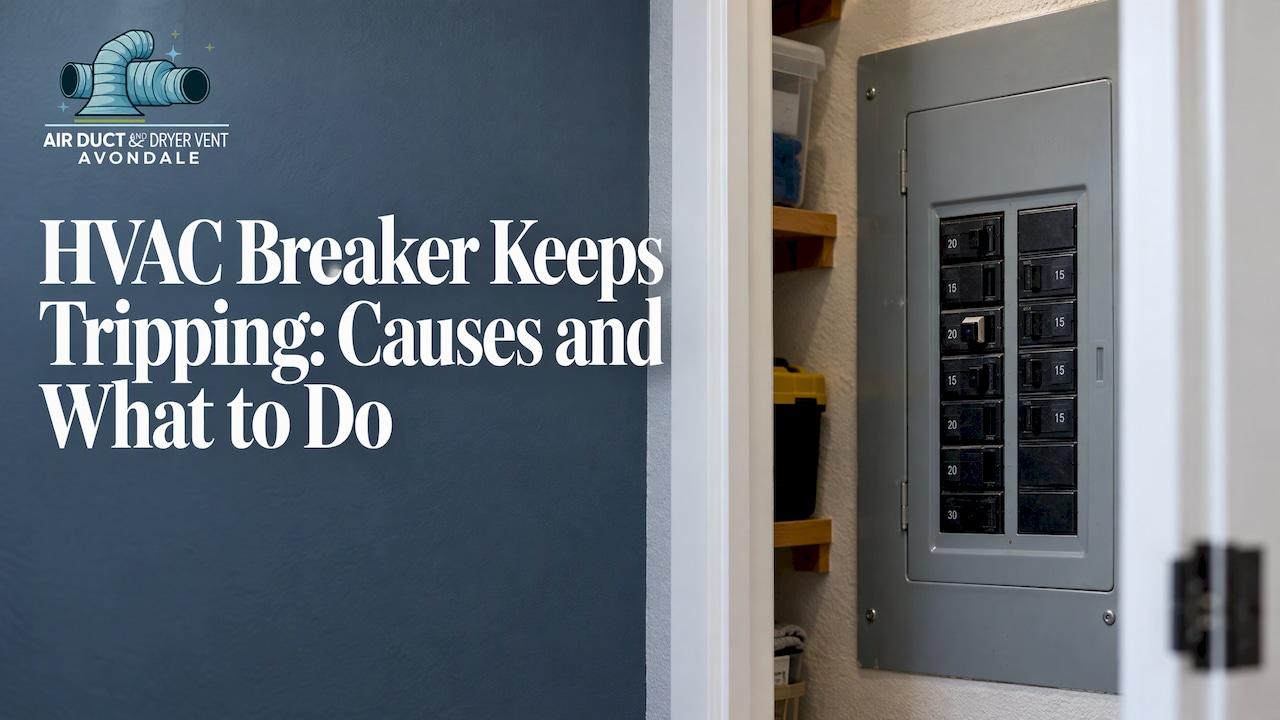
A breaker that keeps tripping on your air conditioner or furnace is doing its job: it is cutting power because the system is drawing more current than the circuit should carry. The cause is often restricted airflow, a worn electrical part or a wiring fault, and the right move is to find it rather than keep flipping the switch. If you are in Avondale, our team handles A/C repair and heating services for homes and businesses, so you can get the system looked at before a small problem becomes a failed compressor.
TL;DR
- A tripping breaker is a safety device reacting to an overload or an electrical fault. It is not the problem itself.
- Common causes include dirty filters and blocked vents, a failing capacitor or contactor, a weak breaker, damaged wiring, and a seized compressor or fan motor.
- You can safely check the thermostat, the filter, the vents and the disconnect switch. You should not keep resetting the breaker or put in a bigger one.
- If the breaker trips a second time after a proper reset, switch the system off and have a qualified professional inspect it.
- Never open the electrical panel or swap breakers yourself. That work belongs to a licensed professional.
Table of Contents
- What a tripping breaker is telling you
- Common causes of an AC breaker tripping
- Why a furnace breaker trips
- Safe checks you can make first
- How to reset a tripped breaker safely
- When to stop and call a professional
- Why you should never keep resetting or upsize the breaker
- Why airflow is worth fixing first
- What to tell your technician
- Our approach to a breaker that won't stay on
- Getting your system looked at in Avondale
- FAQ
- Sources
What a tripping breaker is telling you
A circuit breaker is a switch that opens automatically when too much current flows through a circuit. Carrier describes a tripped breaker as a safety mechanism that cuts power during an electrical overload. The breaker protects the wiring in your walls from overheating. It also protects you.
An air conditioner is one of the hardest-working electrical loads in a home. The compressor and the outdoor fan motor pull a large burst of current when they start, then a steady load while they run. Anything that makes those parts work harder, or that leaks current where it should not, pushes the system toward the breaker's limit.
This is why the pattern matters more than the single trip. Ask yourself:
- Does it trip the moment the system starts, or after it has run for a while?
- Does it happen only on the hottest afternoons?
- Does it happen with the AC, the furnace, or both?
- Did anything change recently, such as a filter that was skipped, a new appliance on the same circuit, or a storm?
Those answers help whoever diagnoses the system. Write them down before you call.
Common causes of an AC breaker tripping
Rheem's technical bulletin on this exact problem lists the usual suspects: a weak or bad circuit breaker, a burnt or bad breaker panel or service disconnect, burnt or broken power wiring, a bad compressor start or run capacitor, a burnt compressor contactor, a bad outside fan motor or its capacitor, and a locked compressor. Here is what those mean in plain terms.
Restricted airflow
This is the cause a homeowner can influence most. When air cannot move freely across the indoor coil or through the ducts, the system runs longer and hotter. A clogged filter, closed or blocked registers and a choked return vent all do this. Our guides on why HVAC airflow drops and on fixing a clogged return air vent walk through what to look for.

In Avondale, where cooling systems run for long stretches in summer, dust that settles in ducts and on filters has a lot of time to build up. If airflow is the root issue, a professional air duct cleaning and a fresh filter address it at the source.
A failing capacitor
A capacitor is a small component that gives the compressor and fan motors the jolt they need to start and keep turning. When one weakens, the motor strains to start and draws too much current. If your air conditioner has trouble starting and then the breaker trips, a bad capacitor is a classic reason. It is a common repair, but it stores an electrical charge even when the power is off, so it is a job for a technician.
A worn contactor
The contactor is the relay in the outdoor unit that sends power to the compressor and fan when the thermostat calls for cooling. Over many cycles its contacts can burn or pit. A damaged contactor can cause overheating, buzzing, or a breaker that trips as soon as the unit tries to start.
Fan motor or compressor trouble
A bad outdoor fan motor lets the unit overheat. A compressor that is seized, or whose windings have shorted to ground, will trip the breaker almost immediately. These are serious repairs, and the earlier a system is shut off, the more likely the damage stays contained.
A weak breaker or damaged panel parts
Breakers wear out. Repair Clinic notes that a weak breaker can trip before it reaches its rating. Loose or burnt connections at the breaker, the panel or the outdoor disconnect can also generate heat and nuisance trips. Diagnosing this requires someone qualified to open the equipment and measure, because the breaker may be reacting to a real problem downstream.
Damaged or loose wiring
The power wiring to the outdoor unit runs through heat, sun and sometimes pests. Insulation that has cracked or been chewed can let current leak to ground. That is a shock and fire risk, and it is another reason a repeat trip should never be ignored.
Why a furnace breaker trips
The same logic applies in winter, with a few differences. Trane says airflow problems are the most common reason a furnace trips its breaker: clogged filters, blocked supply registers and blocked return vents make the furnace work harder and draw more current. Trane recommends checking the filter and changing it every 30 to 90 days.
Other furnace causes include:
- Blower motor trouble. A motor that is wearing out or struggling draws extra current.
- Draft inducer motor failure. This small motor moves combustion gases out of the furnace.
- A damaged wire harness or a shorted control board. Repair Clinic lists both among the components that can keep tripping a furnace breaker, alongside a weak breaker.
- A shared circuit. Trane notes that most homes put the furnace on its own circuit, but in older homes it may share one, and running a high-draw device like a power tool on the same circuit can trip it. Moving a furnace to a dedicated circuit is work for a licensed electrician.
If you heat with a gas furnace and notice any smell of gas, stop and leave the house, then call your gas utility or 911 from outside. That is a separate emergency from a tripped breaker.
Safe checks you can make first
These steps cost nothing and take about ten minutes. They are the same basic checks manufacturers put in their own guides. Bryant's homeowner checklist, for example, tells you to confirm the thermostat setting, the panel breakers, the outdoor disconnect and the furnace switch, and to see whether the filter needs replacing.
- Check the thermostat. Make sure it is set to the right mode and a sensible temperature. A thermostat that calls for cooling nonstop will keep the system running at full load.
- Look at the filter. If it is gray, matted or you cannot see light through it, replace it. Our filter change step-by-step guide shows the order to follow, and our piece on how filters work in Avondale homes helps you pick the right one.
- Open the vents. Walk the house and make sure supply registers and return grilles are open and not covered by furniture, rugs or curtains.
- Check the outdoor unit from a distance. Leaves, debris or a bag stuck against the unit can block airflow. Do not reach into the unit or remove panels.
- Confirm the disconnect. The outdoor unit has a service disconnect box nearby. It should be in the ON position. Do not open it or pull anything out of it.
- Note what you see. Is there ice on the lines, a burning smell, a humming or buzzing sound? Tell the technician.
What these checks do not include is working inside the panel, the disconnect, or the unit's control compartment. Electrical codes exist for a reason. The National Electrical Code states that its purpose is the practical safeguarding of people and property, and that it is not an instruction manual for untrained persons.
How to reset a tripped breaker safely
One reset is reasonable. Carrier's guidance is to turn the breaker fully off, wait about five minutes, and switch it back on. A breaker that has tripped often sits in a middle position, so you need to push it all the way to OFF before moving it to ON.
Before you reset, turn the thermostat to OFF so the system does not try to start the instant power returns. After the breaker is back on, set the thermostat and listen. If the system starts and runs normally, replace the filter if you have not and keep an eye on it for the next day.
If the system will not start or the breaker trips again, Carrier says to switch it off and have a qualified HVAC professional inspect for an electrical fault. That is the point to stop.
When to stop and call a professional
Turn the system off at the thermostat and the breaker, and book a technician if any of these apply:
- The breaker trips a second time after a proper reset, or trips right away.
- The breaker feels hot, buzzes, or the panel has a burning smell or scorch marks.
- The outdoor unit hums but the fan or compressor does not start.
- You see damaged, melted or exposed wiring at the unit or disconnect.
- Lights dim or flicker when the AC tries to start.
- You have already changed the filter and cleared the vents, and the trips continue.
- The breaker has tripped repeatedly over several days or weeks, even if it resets each time.
For a burning smell, visible scorching or any sign of fire, leave the area and call 911. For a problem inside the electrical panel itself, such as a hot or damaged breaker, a licensed electrician is the right professional. For everything on the equipment side, from capacitors and contactors to motors and airflow, that is an HVAC technician.
Why you should never keep resetting or upsize the breaker
It can be tempting to reset the breaker every time it trips, especially during a hot Arizona afternoon. Repeated resets force the system to try again with the same fault. A shorted motor or a failing capacitor can overheat further each time, turning a modest repair into a compressor replacement.
The other tempting shortcut is a bigger breaker. This is dangerous. The breaker is sized to protect the wire and the equipment. The unit's nameplate lists a maximum fuse or breaker size, and the code ties protection to the compressor's rated current. The IAEI's explanation of the code says the protection must be able to carry the motor's starting current, with a maximum of 175% of the compressor's rated-load current, raised to 225% only when needed to start. A larger breaker than the nameplate allows leaves the wiring unprotected, and it can void the manufacturer's warranty.
That same article points out something helpful about the type of breaker. Since the 2005 code edition, the old HACR marking is no longer required on breakers for HVAC equipment, but the nameplate still governs. If it calls for fuses only, a breaker is not an acceptable substitute. This is exactly the kind of detail a trained technician checks, and a homeowner cannot reasonably be expected to.
Why airflow is worth fixing first
Many tripped breakers trace back to a system that has been working too hard for too long. Dust in the ducts, a neglected filter and a restricted return all force the blower and compressor to labor. That extra load shows up as heat, and heat shows up as wear on capacitors, contactors and motors.
Our article on HVAC system wear explains how this builds up, and our guide to common HVAC issues covers the symptoms that tend to travel with it. Even a high-efficiency filter can be a mistake if the system was not built for it, which is why our overview of HEPA filters in HVAC explains what fits and what restricts airflow.
For small business owners and property managers, the stakes are higher. A tripped breaker on a rooftop unit can take down cooling for a whole suite. Regular upkeep, with filters on a schedule and ducts kept clean, lowers the odds. We also offer commercial air duct cleaning with flexible scheduling for commercial clients, including after-hours options, so service does not have to interrupt your business.
What to tell your technician
A good description saves time and often money. Have these ready when you call:
- Which system trips: air conditioner, furnace, or both.
- Whether it trips at startup or after running.
- How long the problem has been happening and how often it trips.
- The last time the filter was changed.
- Any new appliances or equipment added to the same circuit.
- The make, model and age of the unit, found on the nameplate on the outdoor condenser or furnace.
That nameplate also lists the minimum circuit ampacity and the maximum breaker size, the numbers a professional will compare against what is installed.
Our approach to a breaker that won't stay on
We are a local company that focuses on cleaning and maintaining HVAC systems, not treating it as a side service. That matters for a tripping breaker, because so many of them start with a system that is choked with dust or running on a neglected filter. When we look at an air handler, a return or a duct run, we are looking at the conditions that make a motor and compressor work harder than they should.
Our advice is simple. Do the basic checks, reset once, and if the breaker trips again, stop. Repeated resets and oversized breakers are how a repair turns into a replacement, and how a nuisance turns into a fire risk. We offer A/C repair, heating services, air duct and vent cleaning, air filter replacement and air quality testing for homes and businesses in Avondale, so the airflow side and the equipment side can be handled by one company.
We back our services with warranties and offer bundled discounts and flexible scheduling. If your system is tripping, we would rather you call early than after the compressor has failed.
Shaun
Getting your system looked at in Avondale
If your breaker keeps tripping, our team can inspect the system, address airflow problems at the source and handle A/C repair and heating services. Homeowners can start on our A/C repair page. If you also want to rule out dust and debris as the cause, air vent cleaning and air duct cleaning are available, and we also replace filters and test indoor air quality.
The full list of what we do for residential and commercial properties is on our services page, or you can reach us from the Avondale home page.
FAQ
Why does my air conditioner trip the breaker only on hot days?
On the hottest days the system runs nearly nonstop and the compressor works against higher outdoor temperatures, so it draws more current. A dirty filter, dirty coil or weak capacitor that you do not notice in mild weather can push the load past the breaker's limit. If the trips follow the heat, get the system inspected before the next heat wave.
Is it safe to keep resetting an HVAC breaker?
No. One reset after waiting about five minutes is reasonable. If it trips again, the breaker is reporting a real fault, such as an overloaded motor or a short, and repeated resets can damage equipment or wiring. Switch the system off and have a qualified HVAC professional inspect it.
Can a bigger breaker fix the problem?
No. The unit's nameplate sets the maximum breaker size, and the code limits protection to a percentage of the compressor's rated current. A larger breaker stops tripping by removing protection, which puts the wiring at risk and can void the warranty. The fix is finding why the system draws too much current.
Can a dirty air filter really trip a breaker?
Yes. A clogged filter restricts airflow, so the blower and compressor work harder and draw more current. Trane lists clogged filters and blocked vents as the most common furnace breaker cause, and the same airflow logic applies to air conditioners. Replacing the filter is a safe first check.
Who should I call, an electrician or an HVAC technician?
If the breaker only trips when the HVAC system runs, start with an HVAC technician, since capacitors, contactors, motors and airflow are the usual causes. If the breaker or panel itself is hot, scorched or damaged, or other circuits trip too, a licensed electrician should look at the panel. In Avondale, we can inspect the HVAC side.
Sources
- Rheem technical bulletin FI0041, AC breaker tripping
- Trane, furnace keeps tripping breaker
- Repair Clinic, furnace circuit breaker keeps tripping
- Bryant, HVAC troubleshooting tips
- Carrier, AC unit not turning on
- IAEI Magazine, air-conditioning equipment installations
- Eaton, 2020 NEC code changes brochure