
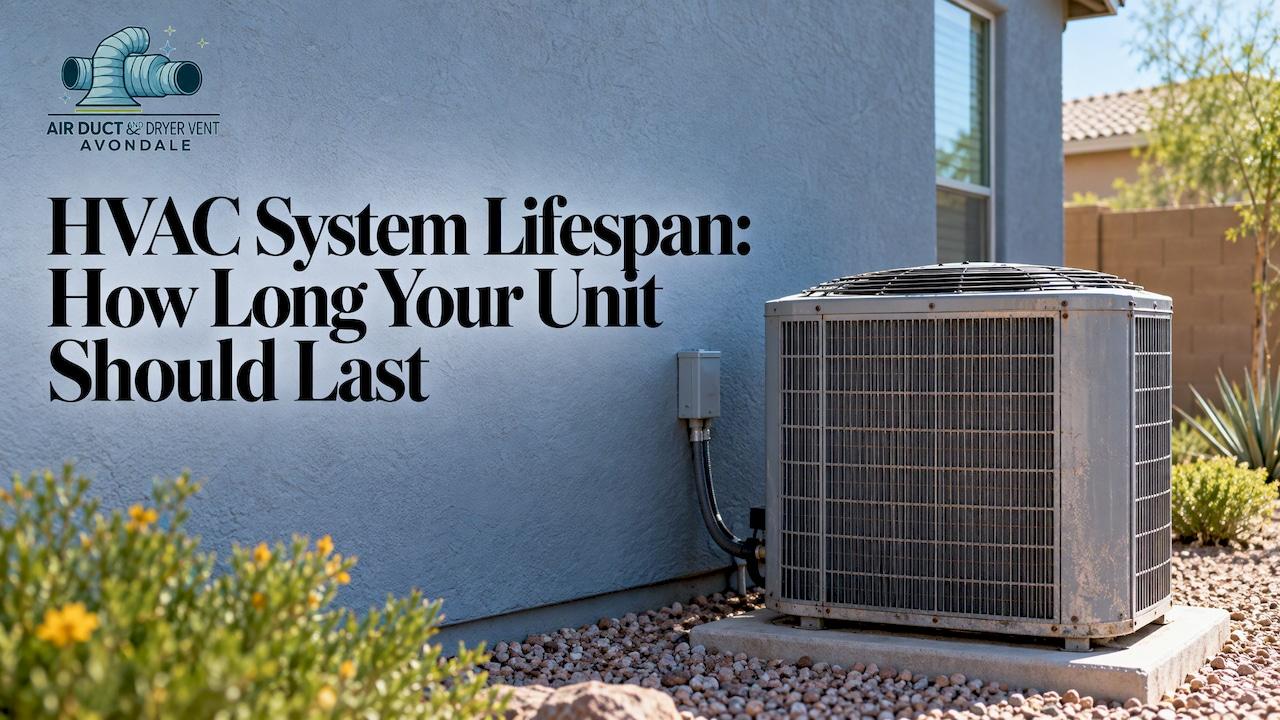
Most residential HVAC equipment lasts somewhere between 10 and 20 years, and the figure depends on the equipment type, the climate, the installation and how well the system is looked after. A central air conditioner usually lands around 15 years, a gas furnace closer to 18, and a heat pump a little less. In a hot desert market like Avondale, where cooling equipment runs for most of the year, the clean, well-maintained system is the one that reaches the top of that range. Our team cleans and repairs duct and vent systems, replaces filters and vents, and handles A/C repair and installation, so this guide covers both how long to expect and what keeps a system running.
TL;DR
- Typical service life is 10 to 20 years: central AC about 15 years, heat pumps about 14, gas furnaces about 18, according to median figures from industry data.
- Hot climates shorten the clock. Observed AC replacement intervals in Texas and Florida run about 10 to 12 years, against 20 or more in cooler northern states.
- At 15 years, federal building guidance treats equipment as near the end of its useful life, and only minor, low-cost repairs make financial sense.
- Clean filters, clear airflow through ducts and vents, and regular professional service are the habits that move a system toward the long end of its range.
- A 30-year system is possible, but it is the exception, not the plan.
Table of Contents
- How long an HVAC system lasts on average
- Lifespan by equipment type
- Why climate cuts years off a system
- The factors that decide where your system lands
- Can an HVAC unit last 30 years?
- Should you replace a 15-year-old HVAC system?
- Signs your system is near the end
- How a clean, well-run system helps over time
- Our perspective
- Keep your system running longer with us
- FAQ
- Sources
How long an HVAC system lasts on average
There is no single number, because "HVAC system" covers several machines with different lives. Published figures differ because they measure different things: design assumptions, the age at which equipment is actually replaced, or what contractors and homeowners expect.
A March 2023 survey of 400 homeowners and 104 contractors shows the gap clearly. 39% of homeowners expected their equipment to last 16 to 20 years, while 47% of contractors expected 11 to 15 years. Homeowners tend to hope for more than field experience delivers.
A useful way to read the range: 10 to 15 years is what you should plan and budget for, 15 to 20 years is what a well-installed, well-maintained system can reach, and anything beyond that is a bonus.
Lifespan by equipment type
Two independent sets of numbers are worth comparing. One is the median service life that ASHRAE and the Department of Energy use, as summarized in a professional service-life document. The other is the median age at which equipment is actually replaced, from ServiceTitan's State of the Trades data published in 2026.
| Equipment | Median service life (ASHRAE) | DOE modeling assumption | Median replacement age (ServiceTitan) |
|---|---|---|---|
| Central air conditioner | 10 to 15 years | 15 years | 15.3 years |
| Heat pump | 10 to 15 years | 14 years | 13.3 years |
| Gas furnace | 15 to 20 years | 18 years | 17.7 years |
| Boiler | 20 to 25 years | not listed | 18 years |
The pattern is consistent. Furnaces outlast air conditioners, and heat pumps tend to wear fastest because one machine handles both heating and cooling. A heat pump works year-round, so it simply accumulates more running hours. If you are weighing the two for a home in our area, our guide to heat pump vs AC for an Avondale home walks through the trade-offs.
The same service-life document notes that DOE rulemaking models central air conditioners at 21 years, while field data often point to 10 to 15 years in typical homes. When you read a headline number of 20 or 25 years, ask whether it describes a design life or what homeowners actually experience.
What about ductwork?
The air conditioner or furnace is only part of the system. Ducts, vents and registers move the air, and they age too. Dust, debris, construction residue and failing joints reduce airflow, which makes the equipment work harder to deliver the same comfort. That is why duct condition belongs in any conversation about system life. We cover this in more detail in our piece on HVAC system wear and your air quality and efficiency.
Why climate cuts years off a system
Running hours matter more than calendar years. ServiceTitan's data on observed AC replacement intervals shows the spread: about 20.7 years in Michigan, 20.6 in Oregon and 20.1 in Washington, against 10.1 in Florida, 11.4 in South Carolina and 12.4 in Texas. The source cautions that climate correlation does not prove causation, but the direction is hard to ignore.

Salt air is one clear example. A contractor on Florida's east coast reported that condensers near the beach may last as little as seven years because of the salty environment. On the other side of the country, a California contractor said systems in his region can last 12 to 25 years when properly installed and maintained, which shows how wide the range becomes once installation and upkeep enter the picture.
For Avondale homeowners the practical reading is this: cooling equipment here works long, hot seasons, so plan on the 10 to 15 year part of the range and treat anything longer as the reward for good care. Fine desert dust also loads filters and ducts quickly, so airflow upkeep matters more than it would in a mild climate.
The factors that decide where your system lands
Installation quality
A unit that is the wrong size, or installed with poor duct connections or an incorrect refrigerant charge, wears out early no matter how good the brand is. An oversized unit cycles on and off constantly. An undersized one runs without rest. If you are budgeting a replacement, our HVAC installation cost guide lists the questions to put to any installer.
Maintenance
This is the factor you control. Typical recommendations from equipment-maintenance checklists include:
- Changing or checking the air filter every month or two during heavy use, and at least every three months otherwise.
- Keeping supply registers and return vents clear of furniture and rugs.
- Keeping the outdoor unit clear of leaves, debris and plants, with a foot or two of space around it.
- Having the system serviced by a professional before peak cooling and heating seasons.
- Scheduling a duct inspection each year.
For a fuller walk-through of what a seasonal service visit covers on the heating side, this furnace maintenance checklist explains what to do yourself and what to book.
Filters are the simplest place to start. A clogged filter restricts airflow, strains the blower and pushes dust into the coils and ducts. Our article on why regular air filter replacement matters for health and efficiency explains how often to swap them and what to look for.
Airflow and cleanliness
Blocked or dirty ducts and vents are one of the quiet reasons equipment works harder than it should. Keeping air moving freely lowers the load on the blower and compressor. We explain the connection in why vent maintenance matters for cleaner air and lower bills, and in why preventing HVAC wear saves money and extends life. If you are not sure when to book a cleaning, see how to schedule HVAC cleaning for better air quality.
Usage
Thermostat settings, how often the system cycles and how many months it runs all add up. Smart thermostats can optimize run times and reduce unnecessary strain, which helps in a climate where the system rarely gets a break.
Can an HVAC unit last 30 years?
Yes, though it is uncommon. Some well-maintained equipment does reach 30 years, and gas furnaces are the most likely candidates. For central air conditioning in a hot climate, it is a long shot. Even when an old unit still runs, it may use far more energy than a current model and rely on parts that are harder to find, so keeping it going is not always the cheaper path.
Should you replace a 15-year-old HVAC system?
Usually you should start planning for it. The Pacific Northwest National Laboratory's Building America Solution Center, a federally funded resource, says that residential equipment more than 15 years old can be assumed to be near the end of its useful life. If performance drops or the unit breaks down after that point, only minor, low-cost repairs are financially justifiable.
The same page adds two points worth knowing:
- Newer equipment can be so much more efficient that replacing a unit that still works can make sense.
- When a major component of a traditional heat pump or air conditioner fails, replacing both the indoor and outdoor units is recommended, because current equipment is matched for efficiency and operating pressure.
A second rule of thumb comes from a cost-per-year guide in the New York Post: if a repair quote exceeds half the cost of a new system and the unit is over ten years old, replacement usually makes more financial sense. The same article quotes a regional manager noting that a 15-year-old system can still be worth keeping, and an eight- or nine-year-old one can be worth replacing, depending on the true cost of ownership.
A simple repair-or-replace test
- Age. Under 10 years: repair. Between 10 and 15: weigh the repair against the rules above. Over 15: expect to replace soon.
- Repair cost. A quote above half the price of a new system points toward replacement.
- Repair history. Two or three service calls in a couple of seasons is a pattern, not bad luck.
- Energy bills. If bills are rising while your usage is not, efficiency is slipping.
- Comfort. Hot and cold spots, humidity problems and noise all count.
Our HVAC system repair guide for Avondale explains what a repair visit involves, so you know what you are paying for before the decision.
Signs your system is near the end
The federal assessment guidance lists reduced comfort, increased energy use or both as signs that a system is nearing end of life. It recommends assessing equipment for these problems:
- Poor comfort control or drafts
- Stale air
- Excessive illness in the household
- Poor humidity control
- Excessive system noise
- High energy bills
A lender-published checklist adds a few more: equipment over 10 years old, climbing bills, frequent and expensive repairs, uneven temperatures, and strange noises, smells or leaks. Any one of these on a system past 12 years is a reason to have it looked at before a summer breakdown forces the decision. For businesses, downtime is the added cost, which is why we wrote about commercial HVAC repair in Avondale.
How a clean, well-run system helps over time
It is tempting to think of lifespan as a fixed number printed on the equipment. In practice it is a running total of stress. Every dirty filter, every blocked return, every season skipped on service adds a little. A system with clean airflow, correct refrigerant charge and tidy ducts also tends to deliver better air and lower bills along the way, which is the point of our guide on how HVAC systems improve air quality and efficiency.
Our perspective
Homeowners usually ask us one question: "How many years do I have left?" The honest answer starts with the system you already have. A unit that is breathing through clean filters, open vents and clear ducts is under far less strain than one that has been fighting for air for ten summers.
That is why we specialize in HVAC cleaning as the core of our work, not an add-on. We use commercial-grade equipment, our technicians are trained for this work, and our services carry warranties. For homes and businesses in Avondale, we also offer flexible scheduling, including after-hours options for commercial clients.
When a system is past the point where repair makes sense, we handle A/C installation and duct installation as well, so the decision about replacement and the work itself stay with one local team that already knows your ductwork.
Shaun
Keep your system running longer with us
If your system is somewhere in the middle of its life, the most useful step is clearing what restricts airflow. We offer air duct cleaning, air vent cleaning and air filter replacement for Avondale homes, and commercial air duct cleaning for businesses and property managers. Our A/C repair and heating services cover the equipment itself, and bundled discounts are available when you combine services.
If you are already looking at replacement, see our A/C installation page, or contact us through our site to book.
FAQ
How long does an HVAC system last?
Most residential systems last 10 to 20 years. Central air conditioners tend to sit near 15 years, gas furnaces near 18, and heat pumps a little under 15, based on median replacement ages. Hot climates and poor upkeep pull the number down.
What is the average life of an HVAC system?
Industry modeling assumes about 15 years for central AC, 14 for heat pumps and 18 for gas furnaces. Treat these as planning figures. Your own equipment may run shorter or longer depending on installation and care.
Can an HVAC unit last 30 years?
It can, particularly a well-maintained furnace. An air conditioner doing long cooling seasons in desert heat is less likely to get there. Regular filter changes and professional service give it the best chance.
Should I replace a 15-year-old HVAC system?
Start planning for it. Federal building guidance says equipment past 15 years is near the end of its useful life and only low-cost repairs are justified. If bills are rising or repairs are frequent, replacing sooner usually costs less than patching.
Sources
- Just How Long Should HVAC Equipment Last? | ACHR News
- Average Service Life of Residential HVAC Equipment | EGIA
- Major home equipment average lifespan | ServiceTitan State of the Trades
- Pre-Retrofit Assessment of Existing HVAC Systems | Building America Solution Center
- How old is too old for an HVAC system? A cost-per-year guide | New York Post
- When Do I Need to Replace My HVAC System? 8 Signs | GoodLeap
- Furnace Maintenance Checklist: What to Do and What to Book