
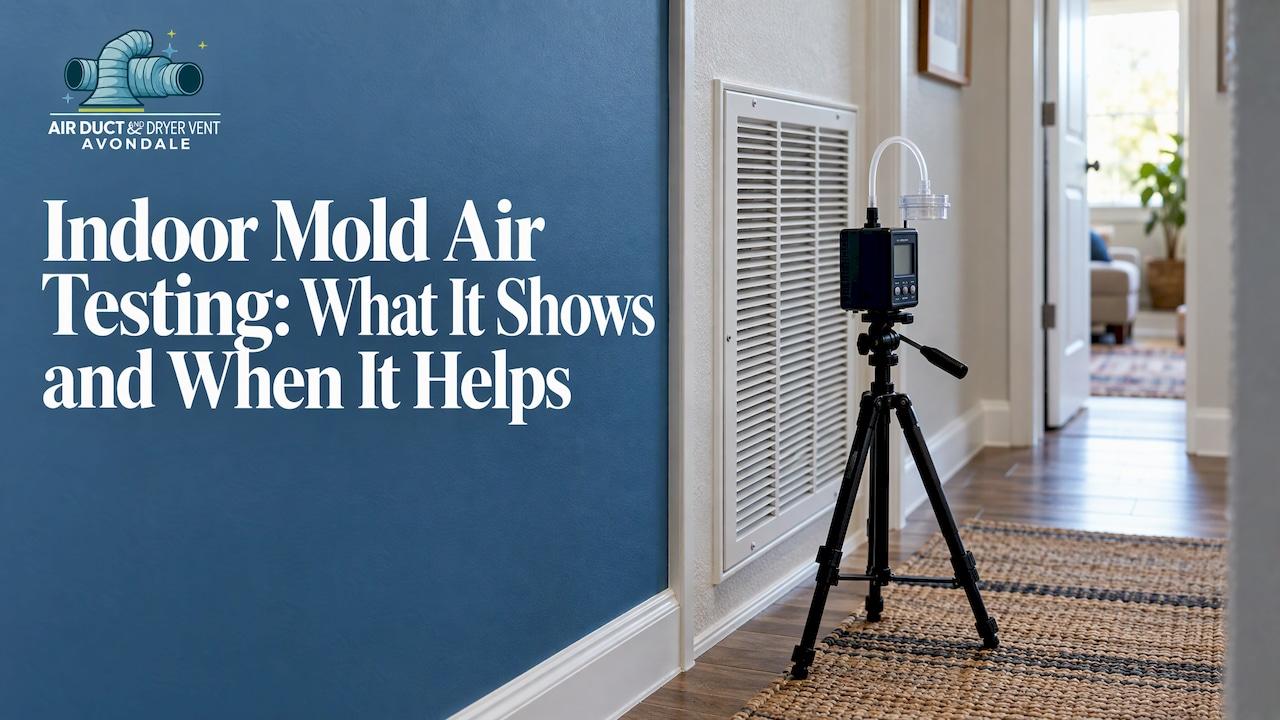
An indoor mold air test collects a short sample of the air in a room and counts the mold spores in it. It can point to a hidden source, but it cannot tell you whether your air is "safe," because no federal limit exists for mold spores. For most homeowners and property managers in Avondale, the best order is: look and smell first, find the moisture, then use air sampling only if those steps leave a real question. When the question involves your ducts or vents, we can inspect and clean them and run an air quality test.
TL;DR
- An air test is a snapshot of one room at one moment. It is a clue, not a verdict.
- The EPA states that no federal limits exist for mold or mold spores, so no result can be checked against a legal "pass" number.
- If you can see or smell mold, the agencies below say testing adds little. Fix the moisture and remove the growth.
- Air sampling is most useful when you suspect hidden mold, for example musty odors or a past water leak with nothing visible, or to confirm cleanup worked.
- Ducts, vents and dryer vents are common hiding places for dust and debris that hold moisture. We clean them and offer air quality testing in Avondale.
Table of Contents
- What an indoor mold air test actually measures
- When air testing is worth doing
- When what you can see and smell is enough
- How an air sample is taken
- How to read the results
- What to do after you find or suspect mold
- Choosing who does the testing
- Where we fit in Avondale
- Our perspective
- FAQ
- Sources
What an indoor mold air test actually measures
Mold spores are in nearly every indoor and outdoor space, so a lab will find some in almost any sample. The Missouri Department of Health and Senior Services notes that mold will always be found in testing. What matters is the type, the amount compared with the outdoor air and where the sample came from.
In a typical test, a small pump pulls air through a collection device for a few minutes. A lab then counts and identifies the spores. The California Department of Public Health explains that mold tests typically count visible or cultured spores, such as Penicillium, Aspergillus or Stachybotrys species.
An air sample has one useful quirk. InterNACHI, a professional inspector association, points out that intact chains of spores usually break apart quickly in air. Finding intact chains can suggest a mold source close by that nobody has spotted yet. The same page adds that an air sample alone is not enough to confirm or rule out a mold problem.
What about "black mold"?
Many readers search this because of the fear around black mold. The Missouri Department of Health says there is no conclusive scientific evidence linking inhaled Stachybotrys spores, or any indoor mold, to illness beyond the allergy symptoms already described. It also says "toxic" is an inaccurate label, since many common molds are simply black. An air test can detect Stachybotrys spores if they are in the sampled air. The practical response to any mold, black or not, is the same: find the moisture and remove the growth.
When air testing is worth doing
The Minnesota Department of Health says that testing by skilled investigators can help in three situations:
- Justifying remediation costs. For example, when an insurer, landlord or buyer wants documentation.
- Documenting that cleanup met expectations. A before and after comparison shows whether airborne levels dropped.
- Finding clues to hidden mold. Think of a musty smell that never goes away, or a wall that got wet years ago.
The same page is firm that testing is never a substitute for a thorough visual inspection. The doctors' reference UpToDate adds that if no mold is seen but musty odors or a history of water damage suggest contamination, further assessment is indicated.
For a property manager, a few real scenarios fit this pattern:
- A tenant reports a persistent musty smell, but there is no stain on any wall or ceiling.
- A unit had a plumbing or air conditioner condensate leak that was dried out, and you want proof the cleanup worked.
- A commercial space had a water event above the ceiling tiles, and you need a record for the file.
A health condition is a separate reason. UpToDate says a professional evaluation of a home should follow two things: a confirmed condition known to relate to fungus (such as asthma, allergic rhinitis or sinusitis) and evidence of exposure to a specific fungus that causes it. If someone in your household has a condition like this, talk to their doctor before you spend money on testing.
When what you can see and smell is enough
If there is visible mold, the agencies are consistent. The EPA states that in most cases, if mold growth is visible, sampling is unnecessary. California's health department says that when you can see or smell a dampness or mold problem, you do not need to measure the amount or identify the type. The Illinois Department of Public Health says the same, and adds that no standards exist to judge acceptable amounts.
The reason is practical. Minnesota frames a mold investigation as two jobs: find where the mold is growing and find the moisture source. Its guidance says that if simpler, cheaper methods answer those questions, testing is probably not a wise use of money. A lab report does not change what you do next, which is dry, repair and clean.
So start with a walk-through:
- Look at ceilings, wall corners, under sinks, around windows and near the air conditioner closet for stains, bubbling paint or fuzzy growth.
- Smell for a musty or earthy odor, which is often strongest when the HVAC system starts up.
- Check supply and return vents for dark spots, dust buildup or moisture.
- Note any past leaks, overflowing drain pans or roof damage, and where they were.
Write down what you find with dates and photos. That record is useful for an inspector, an insurer or a landlord conversation, whether or not you test.
How an air sample is taken
A good air test follows a protocol. InterNACHI's guidance describes these conditions:
| Item | Typical practice |
|---|---|
| Location | Near the center of the room, device 3 to 6 feet off the floor |
| Duration | About 10 minutes, or around 5 minutes if indoor activity could alter results |
| Building conditions | Livable spaces, windows and exterior doors shut, air exchangers off |
| Outdoor controls | Windward and leeward samples taken as close in time as possible |
| Weather | Severe thunderstorms or unusually high winds can skew results |
The outdoor control matters most. Indoor spore counts mean little unless you compare them with what was in the air outside at the same time. Avondale adds its own twist: dust events and windy days can change outdoor spore and particle levels, so a sample taken on a gusty afternoon may not represent normal conditions.
The EPA advises that sampling be done by professionals with specific experience in designing sampling protocols, using sampling methods and interpreting results, and that labs follow methods recommended by organizations such as the American Industrial Hygiene Association (AIHA) or the American Conference of Governmental Industrial Hygienists (ACGIH).
What about store-bought kits? California's health department does not recommend do-it-yourself surface or air sampling kits. The sample duration, timing and outdoor comparison are exactly the steps that kits tend to skip, and a single sample is easy to misread.
How to read the results
This is where most readers get stuck. There is no pass or fail number. The EPA says that no federal limits or Threshold Limit Values have been set for airborne mold or mold spores. CDC's NIOSH states there are no health-based standards for mold in indoor air and that short-term spore counts cannot be interpreted in relation to health risks.
So what can a result tell you? In practice, an inspector looks at three things:
- Indoor versus outdoor. Is the mix of mold types indoors similar to outdoors, or does one type dominate inside?
- Room versus room. Does one room differ sharply from the others?
- Indicators of a nearby source. Intact spore chains or types that typically grow on wet building materials can support a closer search behind walls or in the HVAC system.
Two limits are worth keeping in mind. Minnesota warns that a result is a snapshot of one location and one point in time, and that airborne mold can change significantly within hours. California urges caution about any lab or inspector claim that a result says something about your health risk.
NIOSH adds a reason: what people react to in buildings may be mold itself, a compound produced by mold, something related to bacteria or compounds from building materials. That is why its guidance leans on visual inspection and odor detection rather than counts.
A worked example
Say a tenant in a 1,600 square foot Avondale home reports a musty smell near the hallway return vent. You see no stains. A technician checks the return and finds dust and debris built up, and a prior air conditioner drain leak was mentioned last summer.

An air test here makes sense: no visible growth, an odor and a water history, which are exactly the conditions UpToDate describes. The lab report comes back with higher counts of a water-loving mold type in the hallway than outside or in the bedrooms. That does not say anyone is in danger. It says: look near the hallway return, the closet and the drain line. The inspection finds a damp spot, the leak is fixed, the area is cleaned and the vent system is cleaned. A second sample later documents that the hallway now looks like the other rooms.

Notice what drove the outcome: the odor, the history and the moisture search. The test directed the search and then documented the result.
What to do after you find or suspect mold
The NIOSH guidance is simple. Thorough visual inspection and musty odor detection are more reliable than air sampling. It recommends drying wetted materials within 48 hours of getting wet or removing them, repairing the problem to prevent further water entry and using proper containment when remediating mold on materials.
The order that works:
- Stop the water. Fix the leak, drain line, roof or window problem. Mold returns if moisture does. If the source is a damaged exterior, guidance on stopping moisture damage at the roofline shows how water gets in.
- Dry or remove wet materials quickly, within the 48-hour window NIOSH describes.
- Clean or remove the mold with containment so spores are not spread through the house.
- Check the HVAC system. Ducts move air through every room, so a mold or debris problem there spreads its effects. Our guides on mold in HVAC systems and signs of mold in air ducts explain what to look for, and how to safely remove mold from vents covers the process.
- Prevent a repeat. Our HVAC mold prevention tips cover filters, drain pans and humidity habits.
If you manage commercial property, the same logic applies at larger scale. Our facility manager's guide to preventing mold in commercial ducts walks through it.
If anyone in the building has asthma, allergies, a weakened immune system or other breathing problems, ask their doctor how to limit exposure during cleanup. Heavy or widespread mold, or mold after flooding or sewage, calls for a qualified remediation professional with containment rather than a quick wipe-down.
Choosing who does the testing
The EPA says it has no certification program for mold inspectors or remediation firms and keeps no list of them, though some states may. It advises asking about qualifications, training and experience, and checking references. California's health department suggests finding consultants through associations such as IAQA or AIHA, and notes remediators can be certified through NORMI, NAMRI or IICRC.
A few questions help you compare any provider:
- Will the sampler take an outdoor control sample at the same time?
- Which lab analyzes the samples, and which published methods does it follow?
- Will the report explain what the numbers mean, or only list counts?
- Does the provider also look for the moisture source, not just the spores?
- Who handles the cleaning, and does that firm have a financial stake in a bad result? Ask for the testing and the cleanup to be explained separately.
Cost is the other factor. Minnesota notes that testing well is often expensive, and money spent on poor or unneeded testing is money not spent on repairs. That is the argument for beginning with inspection and moisture work, then testing with a specific question in mind.
Where we fit in Avondale
We focus on cleaning and maintaining the systems that move air through your property. For homeowners, that means air duct cleaning, air vent cleaning and dryer vent cleaning. If ducts are damaged, we also handle duct repair and replacement. For businesses and property managers, there is commercial air duct cleaning, and we offer flexible scheduling, including after-hours options.
If you have a question about your indoor air, our air quality test is the place to begin. Our guides on how to test air quality in Avondale homes and best practices in air quality testing explain what to expect.
We use commercial-grade equipment and trained technicians, and we offer warranties on our services. Pricing is not published online, so contact us about your property.
If your concern is dust, debris, allergens or mold in the vents, book a duct or vent cleaning through the Air Duct Cleaning page, or reach us from our home page.
Our perspective
Most people who call us about mold air testing really want to know one thing: is my air okay? A spore count cannot answer that on its own, and the agencies say so plainly. What helps is a clear picture of the whole system.
We specialize in HVAC cleaning. It is not an add-on for us. Ducts, vents and dryer vents collect dust, debris and moisture over the years, and after construction or system wear they can be the reason a room smells off. Cleaning them with commercial-grade equipment removes dust, allergens, mold and debris from the air path in your property.
Our advice is to look and smell first, find the moisture and fix it, then clean the system the air travels through. If you still have a question, an air quality test gives you a documented starting point. We offer flexible scheduling for commercial clients, warranties on our services and bundled discounts when you combine services.
Shaun
FAQ
Can you test the air in your home for black mold?
Yes, a lab can identify Stachybotrys spores if they are in the air sample. A result still cannot show that the air is harmful, since CDC's NIOSH says short-term spore counts cannot be linked to health risk. If you see black growth, treat it as a moisture problem and clean it safely.
Is there a safe level of mold spores in indoor air?
No official number exists. The EPA says no federal limits or standards have been set for airborne mold. Inspectors compare indoor and outdoor samples and one room against another instead.
Should I test if I can already see mold?
Usually not. The EPA says sampling is generally unnecessary when growth is visible. Put the money toward fixing the water source and cleaning, and call a qualified remediation professional if the area is large.
How accurate is an air mold test?
It is accurate for what it measures: the spores in the air during a few minutes. It does not represent the whole day, as Minnesota notes airborne mold can change within hours, and outdoor weather and indoor activity can skew it. Treat it as one clue alongside inspection.
Does cleaning my ducts remove mold from the air?
Cleaning removes dust, debris and mold from the duct surfaces we reach, which is part of improving indoor air. If mold keeps coming back, the moisture source must be fixed as well.
Sources
- Mold Testing or Sampling, US EPA
- A Brief Guide to Mold, Moisture and Your Home, US EPA
- Who Can Test My Home or Clean, Fix and Remediate My Home for Mold, US EPA
- Mold, Testing, and Remediation, CDC NIOSH
- Testing For Mold, Minnesota Department of Health
- Mold, Missouri Department of Health and Senior Services
- Frequently Asked Questions about Mold, California Department of Public Health
- Common Questions and Answers About Indoor Mold, Illinois Department of Public Health
- Air Sampling for Mold Inspections, InterNACHI
- Assessment of mold in the indoor environment, UpToDate
- Stopping moisture damage: fascia and soffit repair