
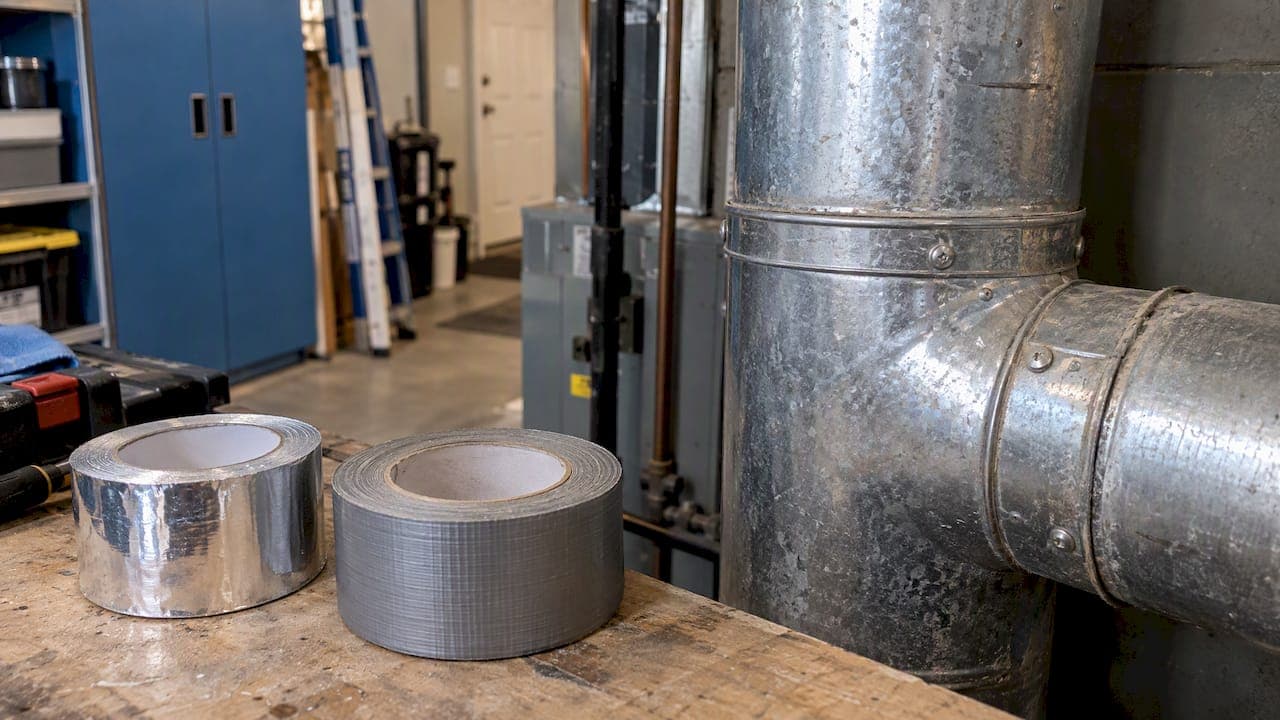
Use foil tape, not cloth duct tape, on metal ductwork and dryer vent joints, and only a foil tape that carries a UL 181 listing. Gray cloth duct tape is made for general repairs, not for hot, dry, vibrating air passages, and it is not what codes and appliance makers point to. Even the right foil tape is only a seal. On a dryer vent, the joint also needs a mechanical fastener such as a band clamp.
This guide explains why, where each tape belongs, and how the duct material you tape (rigid, semi-rigid, foil, aluminum, galvanized, PVC) changes the answer.
TL;DR
- Foil tape with a UL 181 listing is the right tape for metal duct seams. Cloth duct tape is the wrong one, despite the name.
- On dryer vents, tape only seals. Joints need band clamps or listed tie fasteners, and screws that poke into the duct are out.
- Rigid or semi-rigid metal duct, 4 inches in diameter, is the standard choice. Foil-type flexible duct and PVC are not.
- Near a furnace or air handler, mastic with fiberglass mesh beats any tape.
- If your vent has been taped, crushed or run in the wrong material, have it inspected before the next heavy laundry week.
Table of Contents
- The short answer: what each tape is actually for
- Why the "duct tape" name misleads
- Foil tape on dryer vents: a seal, not a fastener
- When tape is not the right answer at all
- The duct you are taping matters more than the tape
- Signs your tape or duct has failed
- A perspective from our crew
- Need a hand in Avondale?
- Quick buying guide: what to put in your cart
- FAQ
- Sources
The short answer: what each tape is actually for
Foil tape is an aluminum foil backing with a strong adhesive, built to bond to metal and handle temperature swings. For HVAC work, the useful versions are listed to the UL 181 family of standards. The U.S. Department of Energy states that dryer duct connections must be sealed with UL 181B or UL 181B-M listed material. That listing is printed on the tape or its core, so you can check it in the store aisle.
Duct tape, in the common sense, is a cloth-backed, rubber-adhesive tape. It is good for bundling, patching and temporary fixes. It was never designed to hold a bond on a warm metal seam for years. The adhesive softens, dries and lets go, and the seam opens up again. The Air Duct Council, an industry group, specifies that tapes for flexible ducts must be listed and marked UL 181B-FX. General-purpose cloth tape carries no such marking.
In short: if the roll does not say UL 181 on it, it does not belong on a duct.
| UL 181 foil tape | Cloth "duct tape" | |
|---|---|---|
| Designed for | HVAC and dryer duct seams | General repairs, bundling |
| Listing to look for | UL 181B-FX, 181B-M or similar | None for ductwork |
| Heat and dry-air behavior | Built to hold | Adhesive tends to dry and release |
| Best surface | Clean, dry metal | Almost anything, briefly |
| Use on dryer joints | Sealing only, with a clamp | Not appropriate |
Why the "duct tape" name misleads
The name dates from a time when cloth tape was used to patch ducts. Building practice has moved on. Researchers who tested sealants for the U.S. Department of Energy's national laboratory network found that the standard UL tests do not fully capture how sealants age, and Walker and Sherman suggest looking at ASTM E2342-03 durability testing in addition. In other words, even listed products vary in how long they last, and unlisted cloth tape is a poor bet.
If you ask a contractor for "duct tape" on a job, they will almost always reach for foil tape. The words are used loosely. What matters is the listing on the roll.
Foil tape on dryer vents: a seal, not a fastener
This is the point most DIY guides miss. A dryer vent has two jobs at each joint: keep the air and moisture in the pipe, and keep the pipe from pulling apart. Tape does the first. It does not do the second.

The North Carolina Office of State Fire Marshal explained in a 2024 interpretation that sealing means such as tape are meant to stop air escaping, while mechanical fasteners, such as nonmetallic tie-straps or metal band clamps, are what prevent duct separation. Separation is especially dangerous in hidden spaces like walls, floors and attics, where lint and hot, moist exhaust can pile up unseen.
There is one more rule that catches people out. The Building America program notes that screws or similar fasteners protruding into a dryer duct must not be used, because they catch lint. So the usual sequence on a metal dryer duct is:
- Slide the male (crimped) end of each section in the direction of airflow, so lint is not caught on the seam edge.
- Secure the joint with a band clamp or listed tie fastener.
- Seal the seam with UL 181 foil tape, pressed down firmly.
- Leave the tape exposed and accessible, so it can be checked at cleaning time.
If your installer used only tape on a dryer joint, or used duct tape at all, that is worth correcting. Our guide to dryer vent code requirements goes through the 4-inch duct rule and what inspectors look for.
Applying foil tape so it lasts
- Wipe the metal clean and dry. Dust, oil and moisture are the main reasons foil tape peels.
- Press with a squeegee or the back of a spoon, working out wrinkles and air pockets.
- Overlap seams generously and wrap the full circumference of a round joint.
- Do not stretch the tape over gaps. Foil tape bridges tight seams, not open holes.
- Cold weather weakens the initial bond, so apply it in mild conditions when you can. In Arizona, the opposite applies: tape in a blazing attic should be a listed, heat-rated product, and it is far easier to work in the early morning.
Foil-faced insulation products are sealed the same way, with matching foil tape at every seam. For a sense of how foil facings and seams work together, see this explainer on SuperFOIL sealing and seams.
When tape is not the right answer at all
Foil tape is excellent on clean metal seams you can reach. It is not the best choice everywhere.
The Department of Energy's Building America guidance says joints, seams and openings near an air handler or furnace should be sealed with fiberglass mesh and mastic, because those spots see more vibration and flexing. The same source says supply systems should be sealed with mastic to be airtight, and that a forced-air system should be pressure-tested for leaks.
A practical way to choose:
| Location | Best sealant |
|---|---|
| Straight metal seams, accessible | UL 181 foil tape |
| Plenum, collars, boots, near the air handler | Mastic with mesh |
| Flexible duct inner liner connections | Tape marked UL 181B-FX, plus a clamp |
| Dryer vent joints | Clamp plus foil tape (seal only) |
| Dusty, oily or damp surfaces | Clean first, or switch to mastic |
If you are wondering what professional sealing costs, see our breakdown of duct sealing cost.
The duct you are taping matters more than the tape
Most people who search for foil tape vs duct tape for a dryer are really asking what to use to connect their dryer. Here is how the common duct types compare.
Rigid vs semi-rigid metal duct
Rigid metal duct is the gold standard for the wall, floor and attic runs. It has a smooth interior, holds its shape and does not sag, so lint has few places to settle. Semi-rigid metal duct is a flexible-looking aluminum duct with a ribbed or corrugated wall that can be bent into place. It is easier to fit in tight spots, but the ridges can catch lint and it can crush.
The Building America guide says dryer transition ducts, the short piece between dryer and wall, can be up to 8 feet and should be UL 2158A-listed, and that some semi-rigid metal transition ducts are UL-listed. The practical rule: use semi-rigid for the short hop behind the dryer, and rigid for everything inside the wall or ceiling.
Also keep run length in mind. Every elbow and foot adds resistance, and our article on the maximum dryer vent length explains the 35-foot rule and what reduces it.

Foil-type flexible duct
The thin, accordion-like foil duct sold cheaply is the one people most often tape together. Whirlpool's venting specifications say not to install flexible metal (foil-type) duct unless it is a specific type identified by the appliance manufacturer as suitable for clothes dryers. The Building America guidance adds that vinyl, nylon and foil ducts are not recommended and will void the warranty of most dryers if used.
Why? The ribbed folds trap lint, the thin wall crushes behind the dryer, and it sags into pockets where lint collects. Taping it does not fix any of that. If your dryer has a foil duct, see why we recommend replacing it in why replace round dryer ducts.
Metal vs PVC
PVC does not belong on a dryer vent. The Building America guide says the cited code requires a rigid or semi-rigid metal duct of galvanized steel or galvanized aluminum, with a smooth interior and a 4-inch diameter, and that PVC pipe is not allowed by modern building standards. GE says plastic ductwork is no longer approved because it can contract at curves and let lint build up, which has caused fires in some cases.
Aluminum vs galvanized steel
Both are acceptable for a dryer vent when they are rigid, smooth and 4 inches. One consumer guide notes that both have smooth interiors that resist lint buildup and that aluminum is softer and dents more readily, while galvanized steel is generally cheaper. In practice:
- Galvanized steel: stiffer, harder to crush, better in exposed or high-traffic runs.
- Aluminum: lighter and easier to cut and fit, fine in protected runs, but easier to dent during installation.
In either case, the tape question stays the same: clamp the joint, then seal with listed foil tape.
Signs your tape or duct has failed
Tape and duct problems rarely announce themselves. Watch for:
- Clothes that take more than one cycle to dry
- A dryer that is hot to the touch, or a laundry room that feels humid and warm
- Lint around the dryer, behind it or at the exterior vent flap
- Peeling, dried or discolored tape at visible joints
- A crushed or kinked duct behind the dryer
- A burning smell during drying
Our checklist of dryer vent fire signs covers what to look for and what to do next, and why lint removal matters explains the airflow and safety side. If the vent exits through the roof, see dryer vent roof problems for the specifics there.
A perspective from our crew
We see taped joints almost every week, and the pattern is the same. Someone ran a foil duct or a few pieces of rigid pipe, wrapped the connections in gray tape and called it done. Two years later the tape has gone brittle in the Arizona heat, the joint has slipped and lint is sitting inside the wall.
Our approach is simple. HVAC cleaning is our core work, not a side service, so we look at the whole path: the transition duct, the joints, the clamps, the tape, the run through the structure and the exterior termination. We use commercial-grade equipment, and our technicians are trained to clean without damaging the duct, then tell you honestly if a section should be replaced instead of patched.
If a vent needs new sections, we replace them with rigid or semi-rigid metal in the right places, clamp the joints and seal them with the right listed tape. We back our work with warranties, and we offer flexible scheduling, including after-hours for businesses.
The right tape costs a few dollars more than the wrong one. The wrong one can cost a house.
Shaun
Need a hand in Avondale?
If you suspect your dryer vent is taped together, crushed or running in the wrong material, we can inspect and clean it, and replace sections where needed. Our dryer vent cleaning service in Avondale covers homes and businesses, and we also handle air duct replacement, air vent cleaning and ductwork repairs.

For property managers and business owners, we offer commercial air duct cleaning with scheduling built around your hours. Visit our main site to request a visit. Pricing is quoted per job, so contact us for an estimate.
Quick buying guide: what to put in your cart
If you are doing a small repair yourself on a duct that is accessible and in good condition, here is what to look for:
- A UL 181 listing on the roll. For flexible ducts, the marking is UL 181B-FX. For dryer duct connections, UL 181B or 181B-M.
- Foil, not cloth. If the backing is fabric, it is the wrong product.
- Band clamps sized to a 4-inch duct for dryer joints. Do not use screws that protrude inside.
- Mastic and fiberglass mesh if you are sealing near the furnace, air handler or large gaps.
- Rigid or listed semi-rigid metal duct. Skip vinyl, foil-type flex and plastic.
If the job involves a long run, a roof exit or hidden sections, it is usually safer to have a professional look at it. Industrial and high-volume equipment has its own rules, covered in why industrial dryers need specialized venting.
FAQ
Can I use duct tape on a dryer vent?
No. Cloth duct tape is not a listed sealing material for dryer ducts, and the adhesive does not hold up to warm, dry air over time. Use foil tape listed to UL 181B or 181B-M, together with a band clamp at each joint.
Is foil tape enough to hold dryer duct sections together?
No. Tape is a sealing means, and fire officials have clarified that mechanical fasteners such as band clamps or listed tie straps are what stop a joint from pulling apart. Use both, and keep screws out of the airstream.
Is semi-rigid or rigid dryer duct better?
Rigid metal is best for runs inside walls, floors and attics because it is smooth and does not sag. Semi-rigid metal is suited to the short transition between the dryer and the wall, where it needs to flex. Both should be metal and 4 inches in diameter.
Can I use a foil dryer vent or PVC pipe instead of metal?
Not as a good choice. Many dryer makers say not to use foil-type flex unless they have specified it, and plastic pipe is no longer approved for dryer exhaust. Using them can void your dryer warranty and lets lint build up.
Is aluminum or galvanized steel better for a dryer vent?
Both work when rigid and smooth. Galvanized steel is tougher and usually cheaper, while aluminum is lighter but dents more easily. Pick based on how exposed the run is.
Sources
- Vent a Clothes Dryer, U.S. Department of Energy
- Dryer duct mechanical fasteners requirement, North Carolina Office of State Fire Marshal
- Duct Sealing, Building America Information Sheet 602
- Frequently Asked Technical Questions, Air Duct Council
- Duct Tape and Sealant Performance, eScholarship
- Proper Clothes Dryer Venting, Building America Solution Center
- Dryer Venting Specifications, Whirlpool
- Dryer Installation Information for Exhaust Ducting, GE Appliances
- Aluminum vs. Galvanized Duct for Dryer Vent, Homesteady