
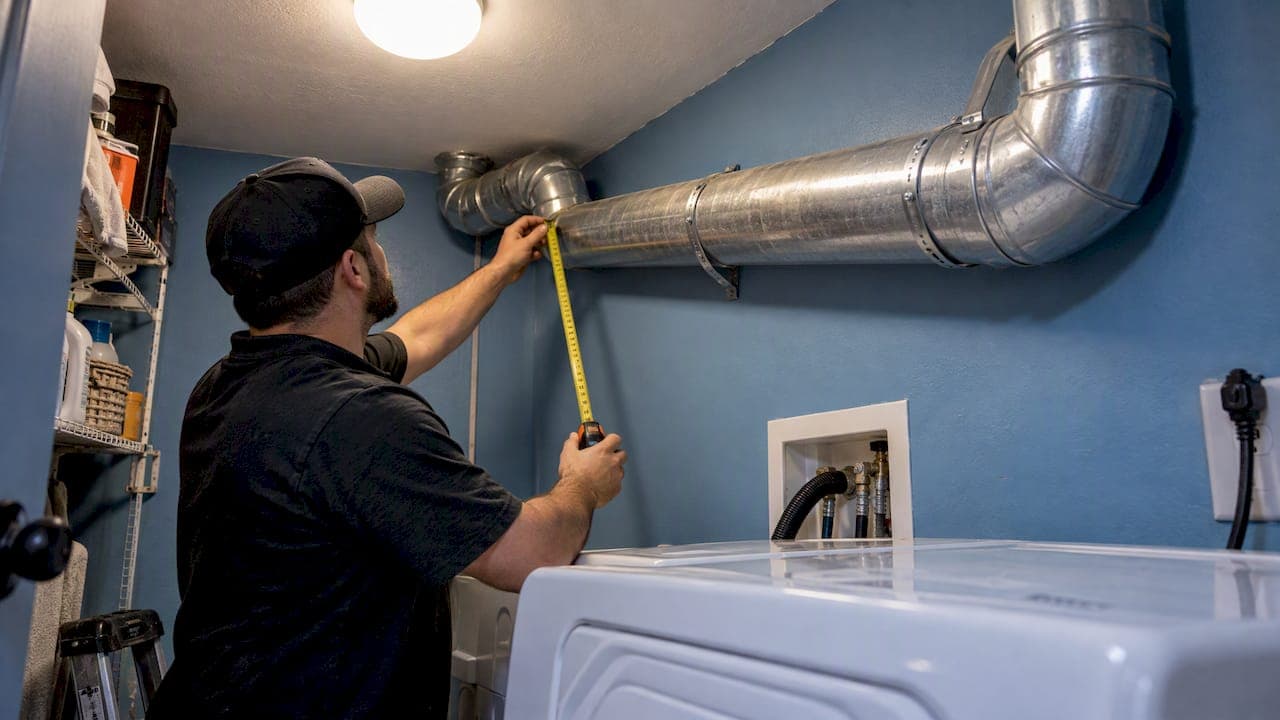
The standard maximum length for a dryer vent in the U.S. is 35 feet, measured from the dryer's transition duct to the outside terminal. That number shrinks with every elbow in the run, and your dryer's installation manual can override it in either direction. If your vent is long, twisty or both, the real question is how much of your 35 feet is already used up.
Below, we show how to count your own run, what the code and manufacturers say, and what to do if the number comes out too high.
TL;DR
- The model codes set a 35-foot maximum for the exhaust duct, from the transition duct connection to the outlet terminal.
- Elbows count against that budget: a 4-inch 90-degree elbow costs 5 feet, and a 45-degree elbow costs 2.5 feet.
- The manufacturer's installation instructions take precedence, so check your dryer's manual before assuming 35 feet.
- If the calculated length goes past 35 feet, the code calls for a permanent label near the dryer connection, and a booster fan is the usual remedy.
- A shorter, straighter run is always better, because lint buildup is what makes long runs dangerous.
Table of Contents
- What the code says about maximum dryer vent length
- How elbows eat into your 35 feet
- Your dryer's manual can change the limit
- What happens when a vent is longer than 35 feet
- Why length matters: lint
- The rest of the duct: rules that count as much as length
- How to shorten or fix a vent that's too long
- Our perspective: length is the number everyone remembers, cleaning is the one that saves you
- Get your vent checked in Avondale
- FAQ
- Sources
What the code says about maximum dryer vent length
The International Residential Code (IRC) and International Mechanical Code (IMC) are the models most U.S. jurisdictions build on. The IRC's section on duct length sets the maximum length of the exhaust duct at 35 feet (10,668 mm), measured from the connection to the dryer's transition duct to the outlet terminal. Where fittings are used, that maximum is reduced according to an equivalent-length table.
Two details trip people up:
- The 35 feet is a budget, not a tape-measure distance. It is an equivalent length, so bends spend part of it.
- It applies to the exhaust duct, not the whole path. The short flexible piece between the dryer and the wall is the transition duct, and it has its own rules (covered below).
Cities adopt and amend these codes on their own schedules. If you are building or remodeling, ask your local building department which edition applies to your address. In the Phoenix metro area, inspectors typically work from the I-Code family, but the exact edition and local amendments are the city's call.
How elbows eat into your 35 feet
Air loses speed at every turn, so lint settles faster there. The code accounts for this by assigning each fitting an equivalent length. According to the IRC fitting table, a 4-inch radius mitered 90-degree elbow counts as 5 feet, and a 45-degree elbow counts as 2 feet 6 inches. Smoother, larger-radius elbows cost less. For example, the same table lists a 10-inch radius smooth 90-degree elbow at 1 foot 6 inches. Most home dryer ducts are 4 inches, though, so the 5-foot and 2.5-foot figures are the ones you will use.

The Building America Solution Center makes the same point: every bend consumes part of your allowance, so a very winding path can exceed the limit even when the pipe itself is short.
The math, step by step
- Measure the straight duct from the transition duct connection to the outside terminal.
- Count each 90-degree elbow and each 45-degree elbow.
- Add 5 feet per 90-degree elbow and 2.5 feet per 45-degree elbow to your measured length.
- Compare the total to 35 feet, or to the number in your dryer's manual if it gives one.
Three worked examples
| Setup | Straight duct | Elbows | Equivalent length | Result |
|---|---|---|---|---|
| Laundry closet on an exterior wall | 8 ft | One 90° | 13 ft | Well within 35 ft |
| Interior laundry room, vent through the attic | 22 ft | Two 90° | 32 ft | Within 35 ft, little room to spare |
| Second-floor laundry, long routing | 25 ft | Three 90° and one 45° | 42.5 ft | Over 35 ft, needs a fix |
Notice that the third home has only 25 feet of pipe. Its owner may well believe the run is short. The elbows are what push it over.
Your dryer's manual can change the limit
The 35-foot figure is the default. The IRC's domestic dryer duct provisions say the manufacturer's installation instructions govern. If the manual for your model allows a different maximum length, longer or shorter, that is the number to follow. Inspectors may ask for a copy of the manual at the concealment inspection.
The U.S. Department of Energy notes in its dryer venting guide that some models are engineered for much longer runs, up to 64 feet or more, but only with the exact ducting the manufacturer specifies, which can include rigid metal duct. Look in the manual's venting section, or search the model number on the manufacturer's site, before you buy ducting or plan a layout.
If the manual lists a shorter limit than 35 feet, that is your ceiling. Do not assume the code number gives you extra room.
What happens when a vent is longer than 35 feet
Sometimes the building simply forces a long run. Two things follow.
A permanent label. When the equivalent length goes beyond 35 feet, the IRC requires the length to be marked on a permanent label or tag within 6 feet of the exhaust duct connection, as laid out in the IRC's exhaust systems chapter. Inspectors look for it.
Airflow help. The Department of Energy's vent a clothes dryer guide says a run that must exceed 35 feet should get a booster fan, and that long runs or excessive bends create a fire hazard and lengthen drying time. We explain how these devices work and when they fit in our post on the dryer vent booster fan.
A booster fan is not a way to ignore the problem. A longer run still collects lint faster than a short one, so it needs more frequent cleaning.

Why length matters: lint
Dryer exhaust carries lint and moisture. The farther it travels, and the more it turns, the slower it moves, and the more lint drops out on the duct walls. That buildup restricts airflow, makes the dryer work harder and is the reason the code is strict about length. We cover the mechanics in why removing dryer vent lint matters and the common causes of dryer vent blockage.
One practical lesson: a short, winding vent can be worse than a longer, straighter one. When you plan or repair a run, shorten and straighten first, then worry about the total.
The rest of the duct: rules that count as much as length
A vent can be under 35 feet and still fail. These are the points inspectors and installers check.
The transition duct
The piece between the dryer and the wall must be a single length listed and labeled to UL 2158A, no longer than 8 feet, and it cannot be concealed inside walls or floors, per the IRC provisions. Flexible plastic tubing and foil-style hose that isn't listed are common reasons for failed inspections.
Smooth metal duct and fasteners
The Building America Solution Center recommends smooth metal duct for the exhaust run. Screws that protrude into the pipe catch lint, so joints should be sealed and fastened without anything sticking into the airstream. The IRC's support rule is part of the same chapter.
The termination point
The exhaust should end outdoors, away from places where it can be pulled back in. Building America guidance puts the termination at least 3 feet from any operable door or window, and ideally 10 feet from HVAC air intakes or condensers, as described in its proper dryer venting guide.
Do not put a screen on the outlet. The Department of Energy's dryer venting guidance notes that screens trap lint. A backdraft damper keeps pests out while letting air and lint leave. If you have a screen today, removing it is one of the quickest safety upgrades available.
Venting through an attic
Many Arizona homes route the dryer duct up and across an attic. That adds length, elbows and a spot where you can't see lint building up. Our article on attic dryer vent risks covers what to watch for. In heat like ours, a long attic run also puts more stress on the duct material, which is one more reason to keep it short and straight.
How to shorten or fix a vent that's too long
Work through these in order, cheapest first.
- Check the manual. Your model may allow more than 35 feet.
- Remove elbows. Each 90-degree bend you eliminate gives back 5 feet. Often a vent can be re-routed to exit through the nearest exterior wall.
- Swap tight bends for gentler ones. Smooth, large-radius fittings count for less than the standard 4-inch mitered ones in the code table.
- Replace flexible duct with smooth rigid metal. It improves airflow and reduces places for lint to catch.
- Move the dryer or the exit point. In a remodel, the cheapest long-term fix is often a different termination wall.
- Add a booster fan and label the run. This is for runs that can't be shortened. Have it installed to the fan manufacturer's instructions.
If your dryer is in a laundry room deep inside the house, a rerouted run usually means opening a wall or ceiling. That is the point where it pays to have a pro look at it before you commit.
Our perspective: length is the number everyone remembers, cleaning is the one that saves you
Most calls we get about long vents begin with, "Is mine under 35 feet?" It's the right first question. But we would rather people ask a second one: "When was it last cleaned?"
We specialize in dryer vent and air duct cleaning. That is our core work, not an add-on to something else. We see how long runs behave in real homes: the more bends and distance, the faster lint collects, and the harder it is to clear with a vacuum hose or a brush kit from a hardware store. A run that technically meets code can still be half blocked.
So our advice is simple. Know your equivalent length. Keep it as short as the house allows. Never rely on a screen or a flimsy foil hose to make a run work. And the longer your run, the shorter the gap between cleanings should be. If you see the warning signs, such as clothes that take multiple cycles to dry or a laundry room that feels hot and humid, take them seriously. Our list of dryer vent fire checks is a good place to start.
— Shaun
Get your vent checked in Avondale
If you live or manage property in Avondale, our dryer vent cleaning service clears lint from the full length of the duct, all the way to the outside termination. We work with commercial-grade equipment and our technicians are trained for this specific job. We also handle air vent and duct replacement when old, damaged or unsuitable duct needs to come out. Scheduling is flexible, including after-hours options. Reach us through the site to book a visit.
For multi-unit buildings, see our dryer vent safety guide for apartments.
FAQ
What is the longest distance you can run a dryer vent?
Under the model codes, 35 feet of equivalent length from the transition duct connection to the outside terminal. Your dryer's manual can allow more or less, and some models are rated for much longer runs with specified ducting. Always follow the manual for your model.
Can my dryer vent be too long?
Yes. A long run slows airflow and lets lint settle, which raises fire risk and makes clothes take longer to dry. If your calculated length goes over 35 feet and the manual doesn't permit it, plan to shorten the run or add a booster fan and the required label.
Can you use a 90-degree elbow on a dryer vent?
Yes, but each one counts as 5 feet of your allowance for a standard 4-inch duct. Use as few as possible, and choose smooth rigid fittings rather than crushed flexible hose.
Does the dryer vent length code apply to the flexible hose behind the dryer?
The transition duct has its own rules: a single UL 2158A listed length, no more than 8 feet, and never hidden inside a wall or floor. The 35-foot limit applies to the exhaust duct beyond it. For more on code basics, see our dryer vent code guide.
Sources
- Specified Length, UpCodes
- IRC 2021 Chapter 15 Exhaust Systems, ICC
- Domestic Clothes Dryer Ducts, UpCodes
- Chapter 15 Exhaust Systems, UpCodes
- Clothes Dryer Exhaust, UpCodes
- Proper Clothes Dryer Venting, Building America Solution Center
- Dryer Venting, U.S. Department of Energy
- Vent a Clothes Dryer, U.S. Department of Energy